
If you’re preparing for the SAT, you’ve probably realized pretty quickly that knowing the material is only part of the challenge.
You also need to know how to apply it.
That’s where SAT practice questions become important.
Working through practice questions can help you understand what the SAT actually asks, find the topics you’re struggling with, improve your timing, and become more comfortable with the digital testing format.
But there’s a catch: simply answering hundreds of random questions doesn’t automatically mean you’re preparing effectively.
A better approach is to use practice questions with a purpose.
Maybe you’re missing too many algebra questions. Maybe Reading and Writing questions take you too long. Maybe you understand the concepts but make careless mistakes under time pressure.
Your practice should help you figure out exactly what’s going wrong.
This guide explains how to use SAT practice questions effectively, where to find official practice resources, how to review your mistakes, and how to build a practice routine that actually fits a U.S. high school student’s schedule.
What Are SAT Practice Questions?
SAT practice questions are questions designed to help students prepare for the skills and question types they will encounter on the actual SAT.
They can be used in several ways.
You might answer a few questions while studying a particular Math topic. You might complete a timed set of Reading and Writing questions. Or you might take a full-length Digital SAT practice test to experience the exam more realistically.
The most useful practice questions generally match the current SAT format and content.
That’s especially important now that the SAT is digital and adaptive.
College Board’s Student Question Bank includes thousands of official SAT Suite questions and allows students to filter questions by section, content domain, skill, and difficulty.
That makes targeted practice much more useful than simply searching the internet for random SAT questions.
Why SAT Practice Questions Matter
A textbook can explain a concept.
A lesson can show you how to solve a problem.
But a practice question forces you to make the decision yourself.
That’s valuable because the SAT isn’t asking you to recite everything you’ve studied. It asks you to recognize what a question is testing and then choose an appropriate approach.
For example, you might know how to solve a linear equation.
But on the SAT, you may need to recognize that an equation buried inside a word problem represents the same mathematical relationship.
The same thing happens in Reading and Writing.
You may know the rules for commas, but you still need to identify which rule applies when you’re looking at an unfamiliar sentence.
Practice helps build that recognition.
Where Can You Find Official SAT Practice Questions?
One of the best places to start is College Board’s official SAT practice resources.
The Student Question Bank contains thousands of official practice questions created by the same organization that develops the SAT. You can filter the questions by test section, domain, skill, and difficulty.
College Board also provides full-length Digital SAT practice tests through Bluebook.
Those practice tests are particularly useful because they let you experience the digital testing environment and adaptive structure before the real exam.
For students who want additional practice, our SAT Practice Test guide can also help you organize your preparation.
Official SAT Practice Questions
For the most reliable practice material, start with College Board’s official Student Question Bank.
You can narrow your practice based on what you actually need to improve.
For example, instead of answering 50 random questions, you could focus on a particular Math skill or Reading and Writing domain.
That makes your study time more efficient.
Should You Use Official SAT Practice Questions?
Yes, official questions are especially useful because they are designed to reflect the actual SAT.
That doesn’t mean every other practice resource is useless.
Third-party practice can help you get additional repetition, learn different explanations, or build endurance.
But when you’re trying to understand what the real SAT feels like, official material should have an important place in your preparation.
This is particularly true as you get closer to test day.
SAT Math Practice Questions
Math is one of the areas where targeted practice can make a noticeable difference.
The current SAT Math section covers four major areas:
- Algebra
- Advanced Math
- Problem-Solving and Data Analysis
- Geometry and Trigonometry
If you’re still building your foundation, start by identifying which areas are causing problems.
For example, you might be comfortable with basic linear equations but struggle with nonlinear equations.
Instead of repeatedly taking full-length tests, spend some time working specifically on nonlinear problems.
Our SAT Math guide can help you review the broader Math topics before moving into targeted practice.
How to Practice SAT Math Questions
Don’t immediately look at the answer after getting stuck.
First, try to figure out where the problem went wrong.
Ask yourself:
Did I misunderstand the question?
Did I choose the wrong formula or method?
Did I make an arithmetic mistake?
Did I run out of time?
Did I know how to solve it but make a careless error?
Those are very different problems.
If you misunderstood the concept, you need content review.
If you knew the concept but made an arithmetic mistake, you may need to slow down and check your work.
If you couldn’t finish because of timing, your issue may be pacing rather than mathematical knowledge.
SAT Reading and Writing Practice Questions
The Reading and Writing section requires a different type of preparation.
You need to become comfortable with short passages and questions involving reading comprehension, evidence, transitions, grammar, punctuation, and expression of ideas.
When practicing, don’t just focus on whether you picked the right answer.
Ask why the correct answer works.
Also ask why the other choices don’t.
That habit is especially useful because SAT answer choices are often designed to look plausible.
Our SAT Reading and Writing guide can help you review the major areas before working through larger sets of practice questions.
SAT Practice Questions by Topic
One of the smartest ways to practice is to organize questions by skill.
Imagine you take a practice test and notice that you missed several questions involving:
- Linear equations
- Ratios and percentages
- Transitions
- Punctuation
You don’t need to spend the next week taking full-length tests.
Instead, practice those specific skills.
This is one reason the College Board Student Question Bank can be useful. It lets students filter questions according to areas such as test section, domain, skill, and difficulty.
Targeted practice gives you a clearer answer to the question:
What should I work on next?
How Many SAT Practice Questions Should You Do?
There’s no magic number.
Doing 500 questions isn’t automatically better than doing 100.
What matters is what happens after you answer them.
If you answer 30 questions and carefully review every mistake, you may learn more than you would from rushing through 100 questions without reviewing them.
A useful routine might be:
10–15 questions: Focused skill practice
20–30 questions: Mixed practice
40–50 questions: Longer timed session
Full practice test: Test-day simulation
The right amount depends on your schedule and current skill level.
A student preparing for the SAT in three months has more flexibility than a student whose test is only two weeks away.
Should You Do SAT Practice Questions Every Day?
You don’t necessarily need to practice every single day.
Consistency is more important than forcing yourself to study seven days a week.
For many students, several focused sessions during the week can be easier to maintain than long daily study sessions.
For example:
| Day | Practice Focus |
|---|---|
| Monday | SAT Math questions |
| Tuesday | Reading and Writing |
| Wednesday | Review mistakes |
| Thursday | Math questions |
| Friday | Reading and Writing |
| Saturday | Timed practice |
| Sunday | Rest or light review |
You can adjust this schedule around school, sports, work, extracurricular activities, and other responsibilities.
The goal is to create a routine you can actually maintain.
SAT Practice Questions vs. Full-Length Practice Tests
These two types of practice serve different purposes.
Practice questions are useful when you’re trying to improve a particular skill.
Full-length tests are useful when you’re trying to understand how you perform across the entire exam.
You need both.
If you’re consistently missing questions about quadratic functions, a full-length test may show you that problem exists, but it won’t give you enough focused repetition to fix it.
On the other hand, if you only practice individual questions, you may never learn how to manage your time across an entire SAT.
That’s why a good SAT study plan combines targeted practice with full-length tests.
When Should You Take a Full SAT Practice Test?
A full-length practice test can be useful at several points during preparation.
At the Beginning
Take one early to establish a baseline.
You want to know where you’re starting.
In the Middle
Take another practice test after you’ve spent some time working on your weaknesses.
This gives you a chance to see whether your preparation is actually helping.
Before Test Day
Take at least one realistic full-length practice test close enough to the real exam that you can use the experience to adjust your strategy.
College Board recommends using Bluebook for official Digital SAT practice tests. These practice tests use the digital testing environment and adaptive structure, giving students an opportunity to become familiar with the experience before test day.
Why Bluebook Practice Matters
If you’re taking the Digital SAT, practicing on a screen is important.
You can also work through targeted Digital SAT practice questions to become more comfortable with the question format before taking a full-length practice test.
You don’t want your first experience with the Bluebook testing environment to happen on the actual SAT.
College Board’s Bluebook practice tests include the digital tools students will encounter during testing, and students can use practice results to review their performance.
This lets you practice things such as:
- Moving through questions
- Marking questions for review
- Using digital tools
- Managing your time
- Working through adaptive modules
- Getting comfortable reading on a screen
The more familiar the interface feels, the less attention you’ll have to spend figuring out the technology.
How to Review SAT Practice Questions
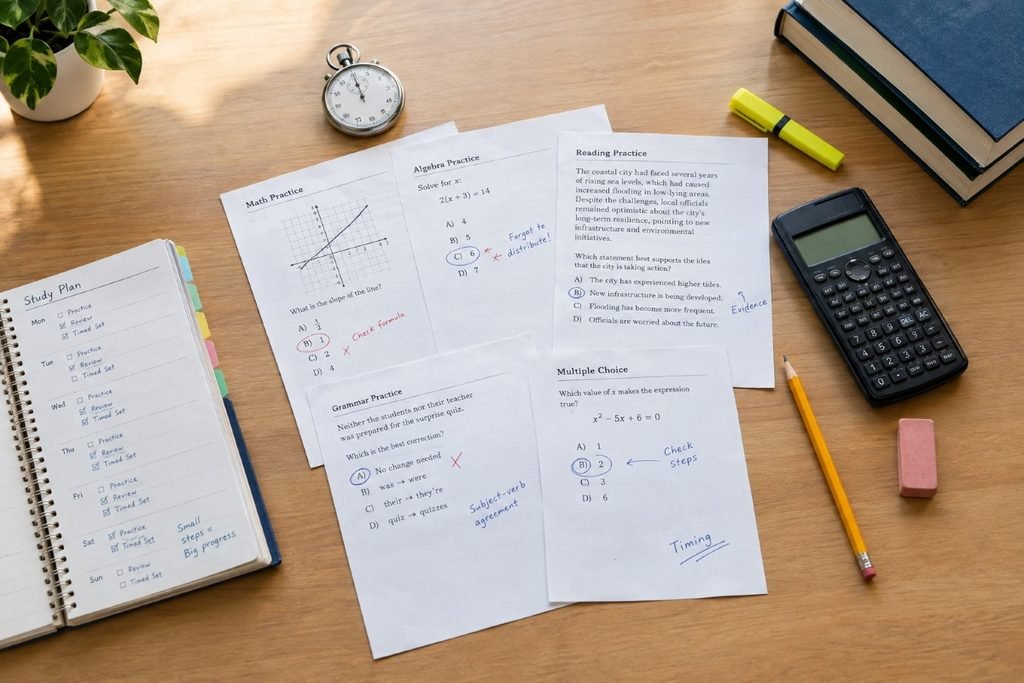
This may be the most important part of your practice.
Don’t just mark a question wrong and move on.
Create a simple mistake log.
For each missed question, write down:
What topic was tested?
What did I choose?
What is the correct answer?
Why was my answer wrong?
What should I remember next time?
You don’t need to write a full essay for every question.
A short note is enough.
For example:
“I chose B because I treated the percentage increase as a percentage-point increase.”
That one sentence tells you what needs to change.
What If You Get a Practice Question Wrong?
Getting a practice question wrong isn’t necessarily bad.
A practice mistake gives you information.
The real problem is making the same mistake repeatedly without understanding why.
When you miss a question, try solving it again before reading the explanation.
Then compare your approach with the correct solution.
If you still don’t understand it, review the underlying concept.
After a few days, try a similar question again.
That final step is important.
You want to know whether you’ve actually fixed the problem—not just whether you understood the explanation for one question.
How to Use Easy, Medium, and Hard SAT Questions
Don’t automatically practice only the hardest questions.
If your fundamentals aren’t solid, difficult questions can become frustrating rather than productive.
A better progression is:
Start With Your Weak Foundation
Make sure you understand the underlying concept.
Move to Moderate Questions
Practice applying that concept in different situations.
Finish With Harder Questions
Once the basics are comfortable, challenge yourself with more difficult problems.
This approach can help you build confidence without avoiding challenging material.
SAT Practice Questions for a 1200, 1300, 1400, or 1500 Goal
Your practice strategy can also change depending on your target score.
A student aiming to move from 900 to 1100 may need to focus heavily on foundational skills.
A student trying to move from 1200 to 1300 may benefit from identifying recurring mistakes and improving consistency.
A student already scoring in the 1400s may spend more time analyzing small errors, timing, and difficult questions.
The important thing is not to assume that every student needs the same study plan.
Your current score and target should determine what you practice.
If you’re trying to understand how your score fits into the broader SAT scale, our SAT Score Chart can help.
You can also read What Is a Good SAT Score? for more context about SAT scores and college goals.
SAT Practice Questions and Score Improvement
Practice questions can help improve your performance, but there is no guaranteed score increase.
Your results depend on factors such as your starting point, preparation time, consistency, and the areas you need to improve.
That’s why it’s better to measure progress in more than one way.
Look at:
- Your practice-test score
- Your accuracy by topic
- Your timing
- Your recurring mistakes
- Your ability to explain why an answer is correct
If your score hasn’t changed yet but you’re making fewer mistakes in a difficult topic, that can still be useful progress.
Common SAT Practice Mistakes
Doing Too Many Random Questions
More isn’t always better.
Target your practice toward actual weaknesses.
Looking at Answers Too Quickly
Give yourself time to solve the problem before checking the explanation.
Ignoring Wrong Answers
Your mistakes are often more valuable than the questions you answered correctly.
Only Practicing Easy Questions
Comfortable questions can build confidence, but they shouldn’t make up your entire preparation.
Never Practicing Under Time Pressure
Knowing how to solve a problem isn’t enough if you can’t finish the module.
Taking Full Tests Without Reviewing Them
A practice test should tell you what to work on next.
If you don’t review it, you’re losing much of that value.
A Simple SAT Practice Questions Strategy
If you’re not sure where to begin, try this process.
Step 1: Take a baseline practice test.
Find out where you currently stand.
Step 2: Identify your weakest areas.
Look for patterns rather than isolated mistakes.
Step 3: Practice those skills.
Use targeted SAT questions.
Step 4: Review every mistake.
Understand why you missed the question.
Step 5: Try similar questions again.
Make sure the concept has actually improved.
Step 6: Take another timed practice test.
See whether your improvements transfer to a longer exam.
Step 7: Repeat the process.
Your practice plan should change as your weaknesses change.
What Are the Best SAT Practice Questions?
The “best” questions are not necessarily the hardest ones.
For most students, the most useful questions are those that:
- Match the current SAT format
- Test the skills you’re trying to improve
- Have clear explanations
- Give you opportunities to learn from mistakes
- Help you practice under realistic conditions
Official College Board questions are particularly valuable because they come from the SAT’s official practice ecosystem. The Student Question Bank currently provides thousands of official questions that can be filtered by skill and difficulty.
Frequently Asked Questions
Where can I find SAT practice questions?
You can find official SAT practice questions through College Board’s Student Question Bank and official practice tests in Bluebook. The Student Question Bank includes thousands of questions that can be filtered by section, domain, skill, and difficulty.
Are official SAT practice questions free?
College Board provides free official SAT practice resources, including practice questions and full-length digital practice tests. Some resources may require you to sign in with a College Board account.
How many SAT practice questions should I do a day?
There is no required daily number. Focus on quality rather than simply counting questions. A smaller set that you carefully review can be more useful than a large set you rush through.
Are SAT practice questions harder than the real SAT?
It depends on the source and difficulty of the questions. Official practice material is designed to help students prepare for the actual SAT, but individual questions can vary in difficulty.
Should I practice SAT Math or Reading and Writing first?
Start with the section where you have the biggest opportunity to improve. A diagnostic or full-length practice test can help you identify that area.
Are SAT practice tests adaptive?
Official full-length Digital SAT practice tests in Bluebook use the same general multistage adaptive model as the digital SAT.
How should I review SAT questions I got wrong?
First try to understand why your answer was wrong. Then identify the underlying skill or concept, review it, and answer similar questions later to make sure you’ve corrected the problem.
Can SAT practice questions improve my score?
Effective practice can help you improve your skills, accuracy, pacing, and familiarity with the test. However, there is no guaranteed score increase.
Should I use SAT practice questions every day?
You don’t have to practice every day. A consistent schedule that fits your school and other responsibilities is usually more realistic than forcing yourself into a routine you can’t maintain.
What is the best way to prepare for the Digital SAT?
Combine targeted practice questions with full-length digital practice tests, mistake review, and timed practice. Becoming familiar with Bluebook is also useful before test day.
Final Thoughts
SAT practice questions are most useful when you treat them as a learning tool—not just a score test.
Don’t worry about how many questions you can complete in one sitting.
Instead, focus on what each question can teach you.
If you miss a Math question, figure out whether the problem was the concept, the setup, the calculation, or the timing.
If you miss a Reading and Writing question, understand why the correct answer fits the passage or sentence and why the other choices don’t.
Then practice that skill again.
Over time, those small improvements can add up.
Start with official resources when possible, use targeted questions to work on weak areas, take realistic Digital SAT practice tests, and review your mistakes carefully.
The goal isn’t simply to become someone who has answered thousands of SAT questions.
The goal is to become someone who knows how to approach the questions that appear on the actual SAT.
That’s what makes practice count.



2 Comments
[…] our SAT Practice Questions resource when you want to focus on individual questions instead of taking a complete practice […]
[…] you’re looking for practice material, our SAT Practice Questions resource can help you work through different question […]