
If you’re preparing for the SAT and wondering how to improve your Reading and Writing score, the first thing to know is that this section is more predictable than it may seem.
You don’t need to memorize every grammar rule in the English language or read hundreds of difficult books before taking the test. The SAT Reading and Writing section focuses on a specific group of skills, including understanding information, analyzing how a passage is written, choosing effective transitions, and applying standard English conventions.
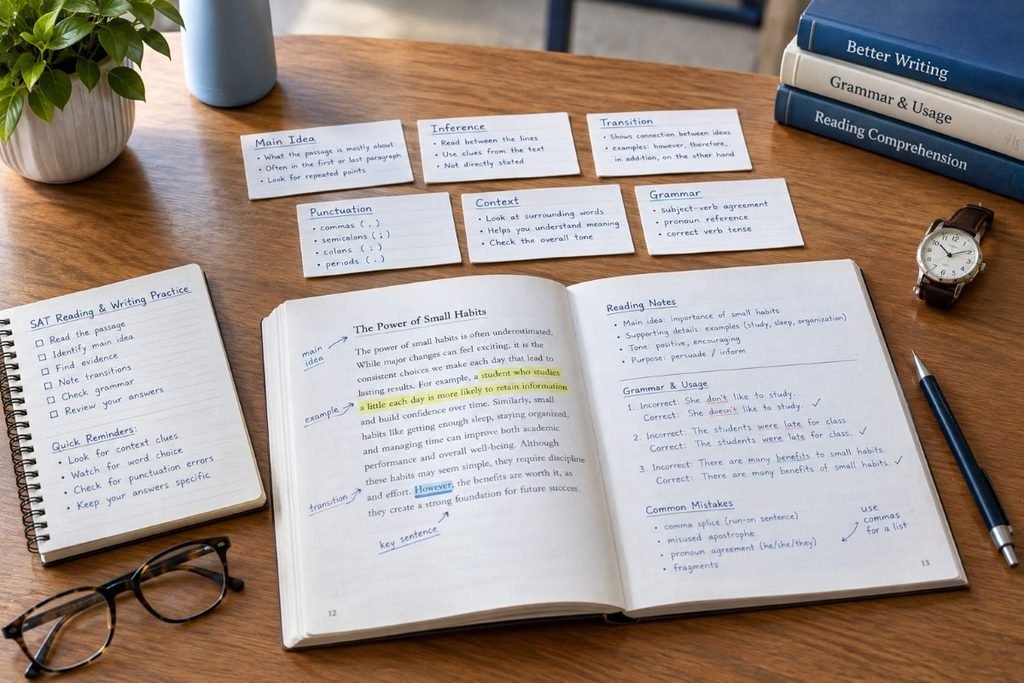
The bigger challenge for many students is learning how to recognize what a question is really testing.
A grammar question might look like a simple punctuation problem. A reading question might appear to be asking about the main idea when it is actually testing an inference. A transition question may require you to understand the relationship between two ideas rather than simply choosing the transition word that sounds best.
Once you understand these patterns, preparation becomes much more manageable.
This guide explains what is on SAT Reading and Writing, the four major content areas, how to approach different question types, how to manage the 64-minute time limit, and how to build a study plan that can actually improve your score.
What Is the SAT Reading and Writing Section?
Reading and Writing is one of the two sections on the digital SAT. The other is Math.
The Reading and Writing section contains 54 questions and gives you 64 minutes total. It is divided into two 32-minute modules. Each module includes questions from all four content domains, and the questions generally move from easier to harder within the module.
If you’re also preparing for the other half of the SAT, our SAT Math guide covers the major Math topics, calculator use, timing, and score-improvement strategies.
Here is the basic structure:
| SAT Section | Questions | Time |
|---|---|---|
| Reading and Writing | 54 | 64 minutes |
| Math | 44 | 70 minutes |
| Total | 98 | 134 minutes |
There is also a 10-minute break between Reading and Writing and Math.
The Reading and Writing section uses short passages rather than long reading selections. College Board says passages range from about 25 to 150 words and can come from literature, history/social studies, the humanities, and science.
That short-passage format changes how you should prepare.
You need to read carefully, but you also need to make decisions quickly.
What Topics Are on SAT Reading and Writing?
The section is organized into four major content domains:
- Information and Ideas
- Craft and Structure
- Expression of Ideas
- Standard English Conventions
These categories cover everything from main ideas and evidence to vocabulary, transitions, grammar, and punctuation.
Let’s look at what each one actually means.
1. Information and Ideas
Information and Ideas focuses on your ability to understand what a passage is saying and use evidence to support an interpretation.
Questions can involve:
- Central ideas and details
- Inferences
- Command of evidence
- Information presented in graphics
- Relationships between ideas
For example, a passage might explain how a scientist conducted an experiment.
The question could ask:
Which choice best states the main idea of the text?
Or:
Which finding would most strongly support the conclusion?
These questions aren’t necessarily testing whether you know something about science.
They’re testing whether you can use the information given in the passage.
A Common Mistake
Students sometimes choose an answer because it sounds intelligent or because it is generally true.
That’s dangerous.
SAT questions should be answered using the information provided in the passage.
If an answer is interesting but isn’t supported by the text, it isn’t the answer.
A Better Strategy
After reading the passage, ask yourself:
What is the author actually saying?
Then look for an answer that matches the passage—not one that simply sounds reasonable.
For evidence questions, ask:
Where is the evidence for this answer?
If you can’t point to the relevant part of the passage, be cautious about choosing it.
2. Craft and Structure
Craft and Structure is where many students encounter questions about vocabulary, author purpose, text structure, and connections between passages.
College Board includes:
- Words in Context
- Text Structure and Purpose
- Cross-Text Connections
within this domain.
Words in Context
These questions aren’t simply asking:
“Do you know this vocabulary word?”
Instead, you’re usually given a word in a specific passage and asked which meaning or phrase best fits the context.
That means you shouldn’t automatically choose the definition you memorized in English class.
Read the entire sentence.
Then read the surrounding sentences.
Ask:
What meaning makes sense here?
A familiar word can have a different meaning depending on context.
Text Structure and Purpose
These questions ask why an author included a sentence, phrase, example, or particular piece of information.
For example:
- Why does the author mention this example?
- What is the function of the highlighted sentence?
- How does the second paragraph contribute to the passage?
Don’t focus only on what the sentence says.
Think about what the sentence is doing.
Is it giving an example?
Introducing an idea?
Providing evidence?
Contrasting two viewpoints?
Explaining a result?
That’s usually what the question is testing.
Cross-Text Connections
Some questions ask you to compare two related texts.
You might be asked what both authors would agree about or how one author would respond to an idea from the other passage.
Don’t try to summarize both passages in your head.
Instead, identify the central claim or position of each author.
Then compare those positions.
3. Expression of Ideas
Expression of Ideas focuses on how effectively information and ideas are presented.
This includes:
- Transitions
- Rhetorical synthesis
- Organization
- Effective use of information
College Board identifies Rhetorical Synthesis and Transitions as important skills within this domain.
Transition Questions
Transition questions can be frustrating because several answers may sound grammatically correct.
But the SAT isn’t asking which transition sounds nicest.
It’s asking which transition best expresses the relationship between the ideas.
For example:
However signals contrast.
Therefore signals a conclusion or result.
For example introduces an example.
Similarly shows a relationship between similar ideas.
Before looking at the choices, figure out the relationship yourself.
Ask:
Is the second idea adding information, contrasting with the first, giving an example, or showing a result?
Then choose the transition that matches that relationship.
Rhetorical Synthesis
These questions may provide notes about a topic and ask you to select the sentence that best accomplishes a particular goal.
The important part is the goal.
If the question asks you to introduce a scientist’s major contribution, don’t choose the answer simply because it contains the most information.
Choose the option that accomplishes the stated purpose most effectively.
This is one area where reading the question carefully can save you time.
4. Standard English Conventions
This is the grammar and punctuation part of SAT Reading and Writing.
It includes:
- Sentence boundaries
- Punctuation
- Subject-verb agreement
- Verb forms
- Pronouns
- Modifiers
- Sentence structure
- Other standard English conventions
College Board describes this domain as editing text so it follows core conventions of standard English sentence structure, usage, and punctuation.
For many students, this is one of the most learnable areas because the rules are relatively consistent.
The Grammar Rules Worth Learning
You don’t need to memorize every grammar rule ever written.
Start with the rules that appear frequently in standardized-test questions.
Commas
Know when commas are needed and when they aren’t.
A comma shouldn’t automatically be placed wherever you would naturally pause while speaking.
You should understand commas in:
- Introductory phrases
- Lists
- Nonessential information
- Clauses
- Compound sentences
Semicolons
A semicolon can generally connect two independent clauses.
For example:
The experiment produced unexpected results; the researchers repeated the test.
Both sides can stand as complete sentences.
If one side isn’t a complete sentence, a semicolon may not be appropriate.
Colons
A colon can introduce an explanation, list, or elaboration after a complete clause.
The words before the colon need to form a complete thought.
Subject-Verb Agreement
Don’t let extra words between the subject and verb confuse you.
For example:
The collection of photographs is valuable.
The subject is collection, not photographs.
Verb Tense
Pay attention to the time relationship between events.
If the passage is clearly describing something that happened in the past, an answer that suddenly shifts into the present may be incorrect unless the context supports that change.
How Much Time Do You Have for SAT Reading and Writing?
You have 64 minutes for 54 questions.
That works out to roughly 1 minute and 11 seconds per question on average.
But don’t treat 1:11 as a stopwatch requirement for every question.
Some grammar questions can take 20–30 seconds.
A difficult inference question may take longer.
A better strategy is to use your easy questions to create time for the harder ones.
If you spend two minutes on a question you’re unsure about, you may be giving up valuable time later.
A Simple Pacing Strategy
When you begin a module, don’t panic about the clock.
Read the question carefully and make your best decision.
If you reach a question where you have no idea what the passage is saying, don’t spend several minutes staring at it.
Make a reasonable choice, mark it if appropriate, and move forward.
The goal is not to feel certain about every question.
The goal is to make the best decisions you can within the available time.
How to Improve Your SAT Reading and Writing Score
The biggest mistake many students make is doing practice questions without analyzing their mistakes.
If you miss 20 questions on a practice test, simply doing another 50 questions won’t necessarily solve the problem.
You need to know why you missed them.
Create a mistake log.
For each incorrect answer, record:
| Mistake | What to Ask Yourself |
|---|---|
| Vocabulary | Did I ignore the context? |
| Main idea | Did I focus on a small detail? |
| Inference | Did I assume something not supported by the passage? |
| Evidence | Could I find direct support? |
| Transition | Did I identify the relationship between ideas? |
| Grammar | Did I know the rule? |
| Punctuation | Did I understand the sentence structure? |
| Careless error | Did I read too quickly? |
After a few practice sessions, patterns will appear.
You might discover that you’re not actually struggling with reading.
Maybe you’re losing points mostly on punctuation.
Or perhaps you understand grammar but consistently miss inference questions.
That’s useful information because it tells you exactly what to work on.
Don’t Read Every Passage the Same Way
Different question types require different reading approaches.
For a main-idea question, focus on the overall point.
For an inference question, pay attention to what the passage supports.
For a vocabulary question, concentrate on the surrounding context.
For a grammar question, you often don’t need to spend much time reading the entire passage.
This is one reason SAT Reading and Writing preparation isn’t simply about “reading faster.”
It’s about reading with a purpose.
How to Handle Vocabulary Questions
One of the best things you can do is stop worrying about memorizing enormous vocabulary lists.
Vocabulary questions on the digital SAT are based on words in context.
Instead of asking:
“What does this word mean?”
ask:
“Which meaning makes sense in this sentence?”
Try replacing the word mentally with a simple word.
If the sentence says:
The discovery was significant because…
you might replace the word with important.
Then see whether the sentence still makes sense.
You don’t need to use complicated vocabulary in your own head to answer the question correctly.
How to Approach Main Idea Questions
A common mistake is choosing an answer that is too specific.
Suppose a passage discusses a scientist who developed a new method for studying ocean temperatures.
One answer may focus on one experiment.
Another may describe the broader purpose of the scientist’s research.
If the question asks for the central idea, the broader answer is usually more appropriate.
Think about what the passage is mostly doing, not which sentence contains the most interesting detail.
How to Approach Evidence Questions
For evidence questions, go back to the passage.
Don’t rely entirely on memory.
Find the sentence or idea that supports the answer.
If two answers seem possible, ask which one has stronger textual support.
The correct answer should be defensible from the information provided.
You shouldn’t need outside knowledge to prove it.
How to Approach Transition Questions
Before looking at the choices, identify the relationship.
Imagine you have:
The first experiment produced promising results. ______, the researchers decided to repeat it with a larger sample.
The second sentence follows logically from the first.
You might consider a transition showing a result or continuation of reasoning.
The key isn’t memorizing a list of transition words.
It’s understanding how ideas connect.
How to Study SAT Grammar
Grammar preparation works best when you study rules in groups.
For example, spend one session on punctuation.
Then practice questions involving commas, semicolons, colons, and sentence boundaries.
After that, study subject-verb agreement and verb forms.
Then move to modifiers and sentence structure.
Don’t just memorize a rule and move on.
Practice until you can recognize the rule quickly inside a real sentence.
A Four-Week SAT Reading and Writing Study Plan
Week 1: Take a Diagnostic Test
Start with a full-length practice test.
Don’t worry if the score isn’t where you want it.
The purpose is to identify your starting point.
Review every missed question.
Week 2: Focus on Grammar
Spend this week working on:
- Punctuation
- Sentence boundaries
- Subject-verb agreement
- Verb tense
- Pronouns
- Modifiers
- Sentence structure
Keep a list of rules you repeatedly miss.
Week 3: Focus on Reading Skills
Practice:
- Main ideas
- Inferences
- Evidence
- Vocabulary in context
- Author purpose
- Cross-text connections
Don’t just mark answers right or wrong.
Explain why the correct answer is supported.
Week 4: Mix Everything
Now combine grammar and reading questions.
Practice under time limits.
Take another full-length test and compare your mistakes with your first test.
If you see the same mistake appearing again, that’s the area that deserves more attention.
Where to Get SAT Reading and Writing Practice
Official practice can be particularly useful because you want to become familiar with the actual style of SAT questions.
College Board’s Student Question Bank contains thousands of official practice questions, and students can filter questions by test section, domain, skill, and difficulty.
You can also use our SAT Practice Test resource when you want to build full-length practice into your preparation.
For official SAT practice resources, the College Board Student Question Bank is a useful place to work on specific Reading and Writing skills.
Should You Read More Books to Improve SAT Reading?
Reading regularly can help, but you don’t need to spend every day reading 500-page novels just because you’re taking the SAT.
Instead, expose yourself to different types of writing.
Try:
- Science articles
- Historical writing
- Magazine features
- Short literary passages
- Essays
- Opinion pieces
The goal is to become comfortable with different writing styles and ideas.
But remember that SAT practice is still necessary.
Reading books and practicing SAT questions develop related skills, but they aren’t exactly the same activity.
What If Your Reading Score Is Low?
Don’t automatically assume you are a bad reader.
Look at your mistakes.
If you’re missing mostly grammar questions, you may need grammar instruction rather than more reading.
If you’re missing inference questions, you may need to practice distinguishing what the passage says from what you personally think.
If you’re running out of time, your issue may be pacing.
This distinction matters.
You can’t fix a pacing problem with endless vocabulary memorization.
And you can’t fix a grammar problem simply by reading more novels.
How to Raise a 500–600 Range Score
If you’re currently scoring somewhere in the 500s or 600s on Reading and Writing, focus on the fundamentals first.
Grammar can be a particularly useful area because the rules are learnable and repeat across questions.
At the same time, work on basic reading skills:
- Finding the main idea
- Understanding evidence
- Identifying relationships between ideas
- Using context for vocabulary
Don’t worry about getting every difficult question right immediately.
Build accuracy on the questions you should be able to answer.
How to Improve From the 600s to the 700s
Once your score gets higher, improvement often becomes more about consistency.
You may already understand most of the major concepts.
Now look for patterns such as:
- One careless mistake per module
- Repeated punctuation errors
- Weakness with transitions
- Difficulty with paired passages
- Spending too much time on difficult reading questions
At this level, your mistake log becomes especially important.
A small number of repeated errors can make a meaningful difference.
How to Prepare for a Very High Reading and Writing Score
If you’re targeting a very high score, don’t only practice difficult questions.
You need to become extremely reliable on questions that you should get right.
That means:
Accuracy first. Speed second.
You don’t want to rush through easy grammar questions and lose points because you didn’t notice a punctuation detail.
At the same time, learn when to move on from a difficult question.
High performance isn’t about spending unlimited time on every problem.
It’s about making good decisions consistently.
How SAT Reading and Writing Fits Into Your Total SAT Score
Reading and Writing is scored from 200 to 800, while Math is also scored from 200 to 800.
Together, they produce the SAT total score on the 400–1600 scale.
That means improving Reading and Writing can have a direct effect on your overall SAT score.
If you want to understand your overall SAT performance, our SAT Score Chart can give you a useful reference point.
You can also explore our SAT Score Percentiles guide to understand how a score compares with other SAT test takers.
And if you’re trying to understand what score may be competitive for your college list, our guide to What Is a Good SAT Score? provides additional context.
Don’t Ignore the Rest of Your SAT Strategy
Reading and Writing preparation is only one part of the bigger SAT process.
You also need to think about registration, test dates, scores, and your overall preparation timeline.
If you haven’t registered yet, you can review our SAT Registration 2026 guide.
Knowing your test date also helps you work backward and create a realistic study schedule. Our SAT Test Dates 2026 guide can help with that planning.
The goal isn’t to study every SAT topic every day.
It’s to know what needs attention and give yourself enough time to improve.
Common SAT Reading and Writing Mistakes
Reading Too Quickly
Fast reading isn’t useful if you don’t understand the passage.
Focus on accuracy first.
Choosing an Answer That Sounds Good
An answer can sound intelligent and still be unsupported by the text.
Always return to the passage.
Ignoring Grammar Rules
Some students try to answer grammar questions based on what “sounds right.”
That can work sometimes, but knowing the actual rule is much more reliable.
Spending Too Long on One Question
One difficult question shouldn’t consume several minutes.
Protect your time.
Practicing Without Reviewing
Practice is only half the process.
Reviewing mistakes is where you discover what needs to change.
Memorizing Huge Vocabulary Lists
Vocabulary questions are based on context.
Understanding how words function in sentences is often more useful than memorizing hundreds of obscure definitions.
Frequently Asked Questions About SAT Reading and Writing
How many questions are on SAT Reading and Writing?
The Reading and Writing section has 54 questions divided into two 32-minute modules.
How much time do you get for SAT Reading and Writing?
You have 64 minutes total, with 32 minutes for each module.
What topics are on SAT Reading and Writing?
The four major content domains are Information and Ideas, Craft and Structure, Expression of Ideas, and Standard English Conventions.
Is SAT Reading and Writing hard?
It can be challenging because you have limited time and need to switch between reading, reasoning, vocabulary, grammar, and writing-related skills. However, the question types and tested skills are fairly consistent, which makes targeted preparation possible.
How can I improve my SAT Reading and Writing score?
Start with a practice test, identify your most common mistakes, study those specific skills, and then practice again under timed conditions.
Do I need to memorize a lot of vocabulary for the SAT?
Not necessarily. Vocabulary questions are presented in context, so understanding how a word is being used in a passage is important.
How can I get better at SAT grammar?
Study the major punctuation, sentence structure, agreement, verb, and modifier rules, then practice applying them in SAT-style questions.
How do I get faster at SAT Reading and Writing?
Learn to recognize question types, avoid spending too long on one problem, and practice under realistic time limits. Speed usually improves as you become more familiar with the question patterns.
Should I guess if I don’t know an answer?
If you reach the end of a module with unanswered questions, make sure you submit an answer for each one. During practice, review the questions you guessed on because a correct guess may still indicate a skill you haven’t mastered.
Where can I find official SAT Reading and Writing practice?
College Board’s Student Question Bank provides thousands of official questions that can be filtered by section, domain, skill, and difficulty.
Final Thoughts
SAT Reading and Writing doesn’t have to feel like an endless test of vocabulary and grammar.
Once you understand the four content areas, the section becomes much easier to organize.
Start with the basics. Learn the grammar rules that repeatedly appear. Practice reading for evidence rather than relying on what you think the passage means. Pay attention to transitions and author purpose. Most importantly, keep track of your mistakes.
If you miss a question, don’t just move on.
Ask yourself:
Why did I choose the wrong answer?
That question can be more valuable than completing another ten random problems.
Maybe you misunderstood the passage. Maybe you didn’t know the punctuation rule. Maybe you rushed. Maybe you chose an answer that sounded good but wasn’t supported by the text.
Once you know the reason, you have something specific to improve.
That is the real goal of SAT preparation—not simply doing more questions, but becoming better at the skills the test actually measures.



No Comments