
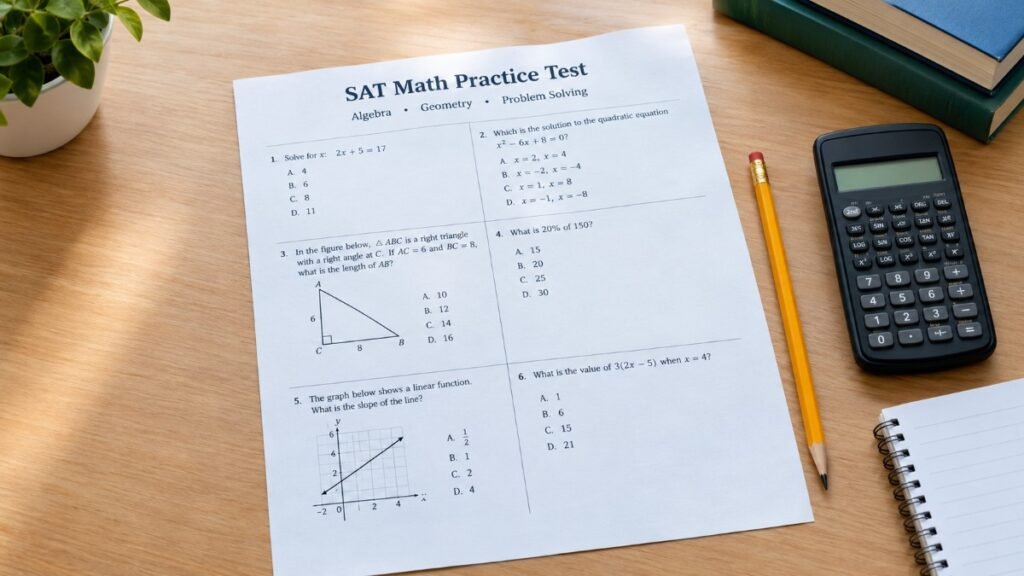
Preparing for the SAT Math section takes more than memorizing formulas. You need to understand mathematical concepts, recognize different question types, and solve problems accurately under time pressure.
This free SAT Math practice test includes 15 original questions covering algebra, advanced math, percentages, ratios, data analysis, geometry, and functions. Every question includes an answer and a step-by-step explanation.
How to use this practice test:
- Try to answer all 15 questions before checking the answer key.
- Show your calculations instead of relying entirely on mental math.
- Review every incorrect answer and identify the reason for the mistake.
- Repeat questions you missed until you understand the solution.
All 15 questions in this practice set are multiple-choice. The actual digital SAT Math section also includes student-produced response questions, where you enter your own answer instead of choosing from four options.
This is an original practice set, not an official College Board test. Your result can help identify areas to review, but it cannot predict your official SAT Math score.
For additional practice materials, visit our SAT practice test resources.
What Is on the Digital SAT Math Section?
The digital SAT Math section has 44 questions and 70 minutes of testing time, divided into two 35-minute modules. The test is adaptive, meaning your performance in the first module helps determine the difficulty of the second module.
According to the official College Board SAT Math overview, the section covers four major content areas.
| Math domain | Skills to practice |
|---|---|
| Algebra | Linear equations, systems of equations, inequalities, and linear functions |
| Advanced Math | Quadratic equations, nonlinear expressions, and exponential functions |
| Problem-Solving and Data Analysis | Ratios, percentages, probability, statistics, and data interpretation |
| Geometry and Trigonometry | Triangles, circles, area, volume, and right-triangle trigonometry |
Calculator use is allowed throughout the digital SAT Math section. However, you should still learn how to set up equations and understand mathematical relationships rather than depending on a calculator for every problem.
For more information about the digital exam, read our guide to digital SAT updates.
SAT Math Practice Test: 15 Questions
Try to complete this set in approximately 22–25 minutes. This is a suggested practice target, not an official timing rule for a 15-question test.
Question 1: Linear Equations
If (3x+7=28), what is the value of (x)?
A. 5
B. 6
C. 7
D. 8
Question 2: Linear Functions
A taxi company charges a fixed fee of $4 plus $2.50 per mile. Which equation represents the total cost (C), in dollars, for a trip of (m) miles?
A. (C=4m+2.50)
B. (C=2.50m+4)
C. (C=6.50m)
D. (C=4m-2.50)
Question 3: Systems of Equations
If
[
x+y=13
]
and
[
x-y=5,
]
what is the value of (x)?
A. 4
B. 6
C. 9
D. 13
Question 4: Percentages
A jacket originally costs $80. Its price is reduced by 25%. What is the sale price?
A. $20
B. $55
C. $60
D. $65
Question 5: Ratios and Proportions
A recipe uses 3 cups of flour to make 12 muffins. At the same rate, how many cups of flour are needed to make 20 muffins?
A. 4
B. 5
C. 6
D. 8
Question 6: Quadratic Equations
What are the solutions to
[
x^2-7x+12=0?
]
A. (x=2) and (x=6)
B. (x=3) and (x=4)
C. (x=-3) and (x=-4)
D. (x=1) and (x=12)
Question 7: Exponential Growth
A science sample contains 200 bacteria. The number doubles every hour. Assuming the growth continues at the same rate, how many bacteria will there be after 3 hours?
A. 400
B. 600
C. 800
D. 1,600
Question 8: Mean and Data Analysis
The numbers in a data set are 6, 8, 10, 12, and 14. What is the mean?
A. 8
B. 9
C. 10
D. 12
Question 9: Probability
A bag contains 5 red marbles and 3 blue marbles. If one marble is selected at random, what is the probability that it is blue?
A. (\frac{3}{5})
B. (\frac{3}{8})
C. (\frac{5}{8})
D. (\frac{1}{3})
Question 10: Slope of a Line
A line passes through the points ((2,3)) and ((6,11)). What is the slope of the line?
A. 2
B. 3
C. 4
D. 8
Question 11: Inequalities
If (4x-3<17), which inequality gives the solution?
A. (x<5)
B. (x>5)
C. (x<4)
D. (x>4)
Question 12: Area of a Triangle
A triangle has a base of 12 inches and a height of 7 inches. What is its area?
A. 19 square inches
B. 42 square inches
C. 48 square inches
D. 84 square inches
Question 13: Pythagorean Theorem
A right triangle has legs measuring 6 units and 8 units. What is the length of its hypotenuse?
A. 9
B. 10
C. 12
D. 14
Question 14: Function Evaluation
A function is defined by
[
f(x)=2x^2-3.
]
What is the value of (f(3))?
A. 9
B. 12
C. 15
D. 18
Question 15: Ticket Sales Word Problem
At a school event, adult tickets cost $12 and student tickets cost $7. A total of 20 tickets are sold, bringing in $190. How many adult tickets were sold?
A. 6
B. 8
C. 10
D. 12
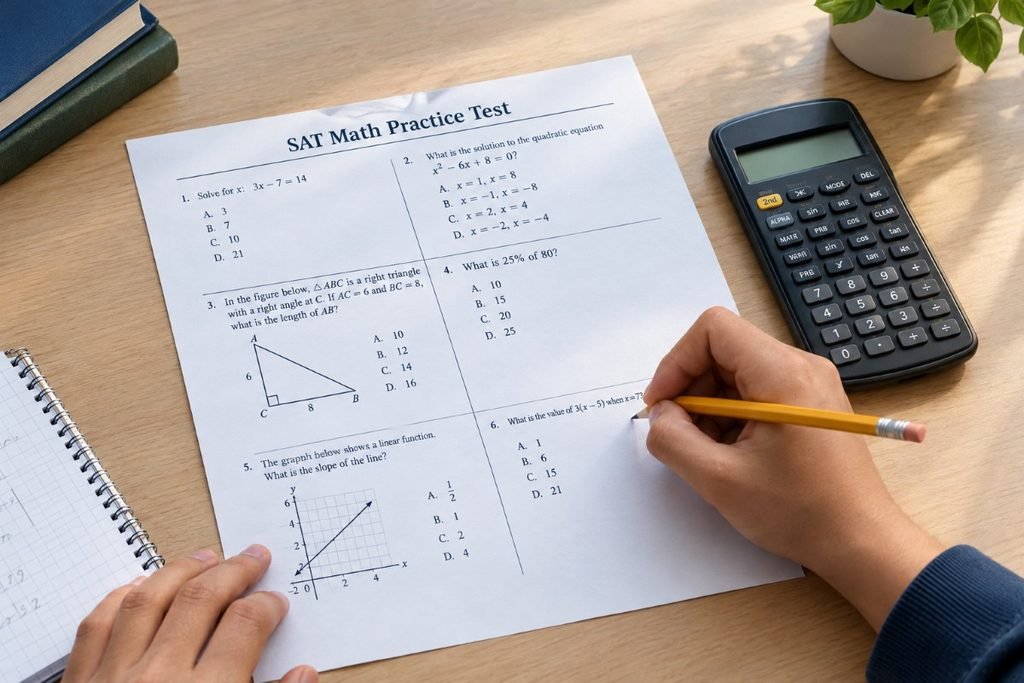
SAT Math Practice Test Answer Key
Check your answers after completing all 15 questions.
| Question | Correct answer | Skill |
|---|---|---|
| 1 | C — 7 | Linear equations |
| 2 | B — (C=2.50m+4) | Linear functions |
| 3 | C — 9 | Systems of equations |
| 4 | C — $60 | Percentages |
| 5 | B — 5 cups | Ratios |
| 6 | B — 3 and 4 | Quadratic equations |
| 7 | C — 1,600 | Exponential growth |
| 8 | C — 10 | Mean |
| 9 | B — (\frac{3}{8}) | Probability |
| 10 | A — 2 | Slope |
| 11 | A — (x<5) | Inequalities |
| 12 | B — 42 | Triangle area |
| 13 | B — 10 | Pythagorean theorem |
| 14 | C — 15 | Functions |
| 15 | C — 10 adult tickets | Systems of equations |
Detailed Answers and Explanations
Answer 1: Linear Equations
Correct answer: C — 7
Start with:
[
3x+7=28
]
Subtract 7 from both sides:
[
3x=21
]
Divide both sides by 3:
[
x=7
]
SAT tip: Undo addition or subtraction first, then multiplication or division. Apply the same operation to both sides of the equation.
Answer 2: Linear Functions
Correct answer: B — (C=2.50m+4)
The taxi charges $2.50 for each mile and a fixed fee of $4. The mileage charge is (2.50m), so the total cost is:
[
C=2.50m+4
]
For a 4-mile trip:
[
C=2.50(4)+4=14
]
The total cost is $14.
SAT tip: In word problems, “per mile” or “per item” usually indicates multiplication. A fixed fee is added once.
Answer 3: Systems of Equations
Correct answer: C — 9
The equations are:
[
x+y=13
]
[
x-y=5
]
Add them together. The (y) terms cancel:
[
2x=18
]
Divide by 2:
[
x=9
]
You can check the result by finding (y=4). Both original equations are satisfied.
SAT tip: Adding or subtracting equations can eliminate a variable and make a system easier to solve.
Answer 4: Percentages
Correct answer: C — $60
A 25% discount means the customer pays 75% of the original price.
[
80(0.75)=60
]
The sale price is $60.
Alternatively, calculate the discount:
[
80(0.25)=20
]
Then subtract it from the original price:
[
80-20=60
]
SAT tip: Read carefully to determine whether the question asks for the discount amount or the final price.
Answer 5: Ratios and Proportions
Correct answer: B — 5 cups
Three cups make 12 muffins. The flour required per muffin is:
[
\frac{3}{12}=0.25
]
For 20 muffins:
[
20(0.25)=5
]
Therefore, 5 cups of flour are needed.
SAT tip: A proportion is useful when two quantities change at a constant rate. Keep the units and order consistent when setting up the relationship.
Answer 6: Quadratic Equations
Correct answer: B — (x=3) and (x=4)
Start with:
[
x^2-7x+12=0
]
The numbers (-3) and (-4) multiply to 12 and add to (-7). Factor the expression:
[
(x-3)(x-4)=0
]
Set each factor equal to zero:
[
x-3=0 \Rightarrow x=3
]
[
x-4=0 \Rightarrow x=4
]
The solutions are 3 and 4.
SAT tip: When factoring a quadratic, check that the two numbers multiply to the constant term and add to the coefficient of (x).
Answer 7: Exponential Growth
Correct answer: C — 1,600
The sample starts with 200 bacteria and doubles every hour.
After three hours:
[
N=200(2)^3
]
[
N=200(8)=1,600
]
The sample contains 1,600 bacteria.
SAT tip: Doubling represents repeated multiplication. Do not treat exponential growth as repeated addition.
Answer 8: Mean and Data Analysis
Correct answer: C — 10
Add the values:
[
6+8+10+12+14=50
]
There are five values:
[
\text{Mean}=\frac{50}{5}=10
]
The mean is 10.
SAT tip: The mean is the sum divided by the number of values. The median is the middle value after the data is arranged in order.
Answer 9: Probability
Correct answer: B — (\frac{3}{8})
There are 5 red marbles and 3 blue marbles, for a total of 8.
The probability of selecting a blue marble is:
[
P(\text{blue})=\frac{3}{8}
]
This equals 37.5%.
SAT tip: For a simple random selection, divide the number of favorable outcomes by the total number of equally likely outcomes.
Answer 10: Slope of a Line
Correct answer: A — 2
Use the slope formula:
[
m=\frac{y_2-y_1}{x_2-x_1}
]
Substitute the points ((2,3)) and ((6,11)):
[
m=\frac{11-3}{6-2}
=\frac{8}{4}=2
]
The slope is 2.
SAT tip: Slope measures the change in (y) divided by the change in (x). Keep the point order consistent in both parts of the fraction.
Answer 11: Inequalities
Correct answer: A — (x<5)
Start with:
[
4x-3<17
]
Add 3:
[
4x<20
]
Divide by 4:
[
x<5
]
The solution is every number less than 5.
SAT tip: Reverse the inequality sign when multiplying or dividing both sides by a negative number. That does not happen in this problem because 4 is positive.
Answer 12: Area of a Triangle
Correct answer: B — 42 square inches
The area formula is:
[
A=\frac{1}{2}bh
]
Substitute the base of 12 and height of 7:
[
A=\frac{1}{2}(12)(7)=42
]
The area is 42 square inches.
SAT tip: The height must be perpendicular to the base. Remember to divide the product of the base and height by 2.
Answer 13: Pythagorean Theorem
Correct answer: B — 10
For a right triangle:
[
a^2+b^2=c^2
]
Substitute the two legs:
[
6^2+8^2=c^2
]
[
36+64=100
]
Take the square root:
[
c=10
]
The hypotenuse is 10 units long.
SAT tip: The hypotenuse is opposite the right angle and is the longest side of a right triangle.
Answer 14: Function Evaluation
Correct answer: C — 15
The function is:
[
f(x)=2x^2-3
]
Replace (x) with 3:
[
f(3)=2(3)^2-3
]
Evaluate the exponent first:
[
f(3)=2(9)-3=18-3=15
]
The answer is 15.
SAT tip: Follow the order of operations. Exponents are evaluated before multiplication and subtraction.
Answer 15: Ticket Sales Word Problem
Correct answer: C — 10 adult tickets
Let (a) be the number of adult tickets and (s) the number of student tickets.
The total number of tickets is 20:
[
a+s=20
]
The total revenue is $190:
[
12a+7s=190
]
From the first equation:
[
s=20-a
]
Substitute into the revenue equation:
[
12a+7(20-a)=190
]
Expand and simplify:
[
12a+140-7a=190
]
[
5a=50
]
[
a=10
]
Therefore, 10 adult tickets were sold. The remaining 10 tickets were student tickets, and the revenue is (120+70=$190), which matches the question.
SAT tip: In word problems, define your variables and translate each condition into an equation before solving.
How to Interpret Your Practice Test Results
Use your score on this 15-question set to decide what to review next. These ranges are informal study suggestions, not official College Board score bands.
| Correct answers | Suggested next step |
|---|---|
| 13–15 | Review mistakes and try harder mixed-topic questions. |
| 10–12 | Focus on the skills behind your incorrect answers. |
| 7–9 | Review core concepts and practice one topic at a time. |
| 0–6 | Strengthen foundational algebra and arithmetic before moving to harder questions. |
Do not convert this result directly into an SAT Math score. The official test is longer, adaptive, and uses its own scoring process.
To learn more about SAT score interpretation, read our guides to what makes a good SAT score and SAT score percentiles.
How to Improve Your SAT Math Score
1. Take an Official Diagnostic Test
Start with an official full-length digital practice test to understand the format, timing, and areas where you need improvement. College Board provides practice information through its Bluebook practice page.
2. Keep a Mistake Log
Record each question you miss, why you missed it, and the correct method. Common reasons include misunderstanding a concept, making a calculation error, misreading the question, or spending too much time on one problem.
Review this log regularly instead of repeatedly practicing only the questions you already know how to solve.
3. Practice Weak Topics
If you struggle with linear equations, spend time solving those problems before moving to harder mixed-topic sets. Once your accuracy improves, combine different topics to practice recognizing the correct method.
You can find more exercises in our SAT practice questions resource.
4. Use Official Questions for Targeted Practice
The College Board Student Question Bank lets students explore official questions by content area and skill. Use the official SAT Math Student Question Bank to work on specific weaknesses.
5. Take Another Timed Test
After targeted review, take another full-length practice test and compare your performance. Look for improvements in accuracy, pacing, and the number of recurring mistakes rather than judging progress from a single result.
For a more structured preparation routine, use our SAT prep study guide and SAT study plans.
Common SAT Math Mistakes to Avoid
Rushing through the question: Read what the problem asks you to find before choosing an answer. A discount amount is not the same as the final price.
Ignoring negative signs: Work carefully when expanding expressions, factoring quadratics, or moving terms across an equation.
Using the wrong formula: Review the formulas for slope, triangle area, and the Pythagorean theorem, and make sure you know when each applies.
Using a calculator without checking the setup: A calculator can help with arithmetic, but an incorrectly entered expression still produces an incorrect result.
Skipping verification: Substitute your answer into the original equation or check it against the conditions in the problem whenever possible.
For additional test-day strategies, read our guide to SAT tips.
Calculator Strategy for SAT Math
Calculator use is allowed throughout the digital SAT Math section. Students can use the testing app’s built-in calculator tools, including Desmos graphing functionality, and may use an approved handheld calculator under the applicable test rules.
A calculator can help with complicated arithmetic, graphs, and numerical calculations. However, you should understand the equation or relationship before entering it.
For example, when finding the slope between two points, first identify the change in (y) and the change in (x). You can then use a calculator to verify the arithmetic.
Practice with the tools you expect to use during the exam, and check College Board’s current calculator rules before test day.
A Simple Four-Week SAT Math Study Plan
Week 1: Identify weaknesses. Take a diagnostic test, review your results, and choose the three topics that need the most attention.
Week 2: Focus on algebra and advanced math. Practice linear equations, systems, functions, quadratics, and exponential relationships.
Week 3: Review data analysis and geometry. Work on percentages, ratios, probability, statistics, triangles, circles, and area problems.
Week 4: Practice timing and review mistakes. Take another full-length practice test, revisit your mistake log, and focus on recurring errors.
Adjust the plan to match your test date and available study time. If you have longer than four weeks, spread the work out so you have enough time to review each topic thoroughly.
Frequently Asked Questions
How many questions are on the SAT Math section?
The digital SAT Math section has 44 questions and 70 minutes of testing time, divided into two 35-minute modules.
Is this SAT Math practice test official?
No. The 15 questions in this article are original practice questions created for study purposes. They are not official College Board questions.
Can I use a calculator on SAT Math?
Yes. Calculator use is allowed throughout the digital SAT Math section. Review the current official guidance on permitted calculators and digital testing tools before your exam.
How should I score this practice test?
Give yourself one point for each correct answer, for a total of 15 points. Review the explanations for every question you missed. This result is a study guide, not an official SAT score estimate.
Which SAT Math topics should I study first?
Begin with the areas where you make the most mistakes. Linear equations, systems of equations, and functions provide useful foundations. Then review advanced math, data analysis, geometry, and trigonometry according to your needs.
How can I improve my SAT Math timing?
Practice solving questions with a clear method and review the topics that slow you down. Accuracy and understanding should come first; speed often improves as you become more familiar with the question types.
Can this short test predict my SAT Math score?
No. This 15-question set is too short to predict an official score. Use full-length official practice tests to evaluate your performance more realistically.
Final Thoughts
Improving your SAT Math performance requires consistent practice, careful review, and a clear plan. Work through these 15 questions, study the explanations, and record the mistakes you want to avoid next time.
Then use official digital practice tests and targeted questions to build confidence across all four Math domains. Focus on understanding the methods behind the answers instead of memorizing solutions. That approach will make your preparation more effective and help you approach test day with greater confidence.


3 Comments
[…] Math is one of the areas you’re working on, our SAT Math practice test offers a way to focus on SAT-style questions. For verbal preparation, the SAT Reading and Writing […]
[…] Explore our SAT Math resources for additional practice and topic review. For focused preparation, you can also use our SAT Math practice test. […]
[…] more focused math preparation, use the SAT Math practice test resource to work through problems and review your […]