

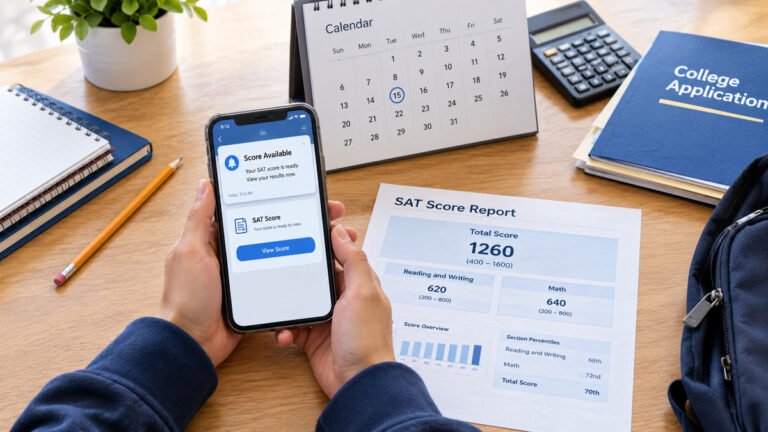
You get your SAT score, look at the number on the screen, and then probably do what almost every student does: you start comparing it.
Maybe you got a 1200 and you’re wondering if that’s good enough for college.
Or perhaps you got a 1500 and are trying to figure out whether you should even take the SAT again.
Maybe you scored 1350 but were hoping for 1400.
The truth is, there isn’t one SAT score that automatically counts as “good” for everyone.
A good SAT score depends on where you want to go to college, what kind of schools you’re applying to, and what those schools’ current testing policies look like.
That’s why a student with a 1200 might feel perfectly comfortable with their score, while another student with a 1400 may decide to retake the test.
In this guide, we’ll break down what different SAT scores actually mean and, more importantly, how to decide what a good SAT score looks like for you.
So, What Is a Good SAT Score?
The SAT is scored from 400 to 1600, with two sections:
- Reading and Writing
- Math
Each section is scored from 200 to 800.
You may see people online describing a certain score as “good,” “bad,” or “average.” Try not to take those labels too seriously.
Your college list is a much better measuring stick.
As a rough guide, here’s how students often think about different score ranges:
| SAT Score | General Take |
|---|---|
| 1500–1600 | Excellent |
| 1400–1490 | Very strong |
| 1300–1390 | Strong |
| 1200–1290 | Good |
| 1100–1190 | Solid |
| 1000–1090 | Around the middle range |
| Below 1000 | May still be suitable for many colleges |
These aren’t official categories from College Board. They’re simply useful ways to put the numbers into perspective.
A 1280 isn’t suddenly a bad score because someone online says you need a 1500.
And a 1500 doesn’t guarantee that you’ll be accepted into your dream school.
The right question is always: How does my score fit with the colleges I’m considering?
Is a 1200 a Good SAT Score?
For many students, yes.
A 1200 SAT score can be a perfectly respectable result, and it can work for a wide range of colleges.
But whether you should be happy with a 1200 depends on your plans.
Suppose you’re looking at colleges where SAT scores commonly fall somewhere around the 1100–1250 range. In that situation, a 1200 may put you in a comfortable position.
Now imagine that most of the schools on your list have students scoring considerably higher. You may decide that another SAT attempt is worth considering.
Neither situation makes the 1200 itself “good” or “bad.”
It simply means the same score can have a different meaning for different students.
If you’ve scored 1200, don’t immediately sign up for another test just because you think you’re supposed to.
First, look at your college list.
Is a 1300 a Good SAT Score?
A 1300 is generally considered a strong SAT score.
For many U.S. colleges, a score in the 1300s can make you a competitive applicant.
If your target schools have typical SAT scores around this range, you may already be where you want to be.
On the other hand, if you’re applying mostly to highly selective universities, you may want to push your score higher.
There’s also another question worth asking: How much could you realistically improve?
If you’re already at 1300 and have limited time before college applications, spending weeks studying for a small increase may not always be the best move.
Your time could also be needed for grades, essays, extracurriculars, or other parts of your application.
Is a 1400 a Good SAT Score?
Yes. A 1400 is a very strong SAT score.
A score in the 1400s can put you in a competitive position at many colleges across the United States.
But if you’re looking at very selective schools, you’ll want to dig deeper.
Check the SAT scores reported by the colleges you’re interested in and see where your 1400 falls compared with their students.
For one school, a 1400 could be right in the middle of the typical range.
For another, it might be below the range you want to target.
That’s why simply saying “1400 is good” doesn’t tell the whole story.
Is a 1500 a Good SAT Score?
A 1500 is an excellent SAT score.
If you’ve reached 1500, you’ve already accomplished something that many students work very hard to achieve.
A score like this can be competitive at a large number of colleges, including many selective schools.
Still, don’t look at 1500 as some kind of guaranteed-admission number.
Highly selective colleges receive applications from students with excellent grades, impressive activities, strong essays, and high test scores.
At that level, every part of your application matters.
If you’re sitting at 1500 and wondering whether to chase 1520, 1550, or 1600, take a look at your actual college list before deciding.
You may find that your time is better spent elsewhere.
Is a 1600 a Good SAT Score?
A 1600 is the highest possible SAT score.
So yes—it’s an exceptional score.
But even a perfect SAT score doesn’t guarantee admission to a highly selective college.
Think of the SAT as one piece of your application rather than the entire application.
If you earn a 1600, that’s fantastic. But you’ll still need to put together a strong overall application.
What SAT Score Do You Need for College?
This is where things get a little more complicated.
There isn’t one SAT score that every college in the U.S. requires.
Colleges have different testing policies, and those policies can change over time.
Some colleges require test scores. Others allow students to apply without submitting them. Some may recommend scores even when they aren’t required.
So before deciding whether your score is good enough, check the current policy for every college you’re considering.
For official SAT information and testing details, you can also visit College Board’s official SAT page.
The important thing is not to rely on a three-year-old article or something someone posted on social media.
College admissions policies can change.
How to Figure Out Your Own SAT Target Score
Instead of asking, “What SAT score should everyone get?” start with a more useful question:
“What score should I aim for based on my college list?”
Here’s a simple way to approach it.
Start With Your College List
Write down the schools you’re seriously considering.
You don’t have to have your final list figured out yet.
Even a rough list of reach, target, and likely schools is enough to start.
Check Their Current Testing Policies
Look at each college’s admissions website and find out how it currently handles SAT scores.
This step matters because a school that had one testing policy a couple of years ago may have a different one now.
Look at Their Student Score Data
If the school publishes SAT information, look at the scores of its students.
You don’t need to obsess over the highest number.
Instead, ask yourself where your score sits compared with the students you’re hoping to join.
Set a Goal That Makes Sense
Let’s say you’re currently at 1180 and the colleges you’re considering generally have students scoring around 1200–1350.
You might set 1300 as a reasonable goal.
If you’re already at 1370 and your target schools are mostly around 1300–1400, you may decide that you’re done.
The goal isn’t to get the biggest SAT number possible.
It’s to get a score that supports your college plans.
What Is a Good SAT Score for Ivy League Schools?
If you’re aiming for an Ivy League school or another extremely selective university, the competition is much tougher.
Many students applying to these schools have very high SAT scores, often in the 1500s.
That doesn’t mean there’s a magic SAT score that gets you admitted.
There isn’t.
A high score can strengthen your academic profile, but selective colleges look at your application as a whole.
So if you’re thinking, “I’ll just get a 1550 and I’ll be fine,” it’s worth changing that mindset.
A better approach is:
Get the strongest SAT score you reasonably can while also building a strong overall application.
What Is a Good SAT Score for Scholarships?
This depends heavily on the scholarship.
Some colleges and scholarship programs use SAT scores as part of their merit scholarship decisions.
Others may focus more on GPA, coursework, extracurricular involvement, leadership, essays, or other factors.
There isn’t a single SAT score that guarantees a scholarship.
If you’re trying to qualify for a particular scholarship, read its current requirements carefully.
A higher SAT score can sometimes help, but don’t assume that getting a certain number automatically means you’ll receive money for college.
Should You Retake the SAT?
This is probably one of the biggest decisions you’ll make after seeing your score.
And honestly, there’s no reason to retake the SAT just because your friend is doing it.
Consider a retake if:
- Your score is below the range you’re targeting
- You know what areas you need to improve
- You have enough time before your college deadlines
- Your colleges consider SAT scores
- You have a realistic chance of improving
On the other hand, you may not need another attempt if you’re already happy with your score.
There’s a point where another 20 or 30 points simply isn’t worth the time and stress.
Look at your situation instead of following a rule that says every student should take the SAT multiple times.
How Much Can You Improve Your SAT Score?
There’s no guaranteed improvement when you retake the SAT.
Some students make a big jump.
Others improve only slightly.
And some don’t improve at all.
What matters is what you do between tests.
Don’t just take another practice test every weekend without figuring out what went wrong the first time.
Look at your results.
Did Math give you trouble?
Were you losing points because you ran out of time?
Did certain question types consistently trip you up?
Once you know the problem, your preparation becomes much more useful.
If you’re getting ready for another SAT attempt, our SAT practice test guide can help you build your preparation around realistic practice.
What If You Got a Lower SAT Score Than You Expected?
First: don’t panic.
It’s easy to feel disappointed when the number on the screen isn’t what you were hoping to see.
Give yourself a little time before making a decision.
Then look at the score more objectively.
Ask yourself:
- Was I prepared?
- Did I struggle with timing?
- Was one section much weaker?
- Did I make mistakes I can realistically fix?
- Do my colleges even require SAT scores?
- Do I have enough time for another test?
You may discover that your score is actually fine for your college list.
Or you may realize that a retake makes sense.
Either way, one SAT score isn’t going to define your entire college application.
What If Your College Is Test-Optional?
“Test-optional” can be confusing.
It doesn’t necessarily mean that SAT scores don’t matter.
If a college allows students to submit SAT scores, you have to decide whether submitting yours would strengthen your application.
One useful thing to do is compare your score with the school’s available student score data.
If your score is competitive, submitting it may make sense.
If it’s significantly below the school’s typical range and the school genuinely allows applicants to apply without scores, you may decide not to submit it.
But don’t make this decision based on a generic rule.
Check the college’s current policy and, if you’re unsure, talk with your counselor or the admissions office.
Does Your SAT Score Matter More Than Your GPA?
Not necessarily.
Your GPA reflects your academic performance over a much longer period.
The SAT, on the other hand, is a standardized test taken on a particular day.
Colleges can consider both, along with many other parts of your application.
Those can include:
- The difficulty of your courses
- Extracurricular activities
- Essays
- Recommendations
- Academic achievements
- Leadership
- Personal circumstances
The importance of each factor varies from one college to another.
So don’t look at your SAT score as if it exists separately from everything else you’ve accomplished in high school.
SAT Score vs. SAT Percentile
You may also see a percentile associated with your SAT score.
Your SAT score is your actual number on the 400–1600 scale.
Your percentile gives you another way to understand how your performance compares with other test takers in the relevant comparison group.
Percentile can be useful when you’re trying to understand your overall performance.
But when you’re deciding whether your score is competitive for college, your target schools’ own admissions data is usually more useful.
What Should You Do After Getting Your SAT Score?
Once you have your score, don’t feel pressured to make a decision immediately.
Take a look at the number.
Then look at your college list.
If you’re happy with where you stand, move forward.
If you’re not, figure out whether another attempt could realistically help.
If you decide to retake the test, check the upcoming SAT dates and make sure you have enough time to prepare.
And don’t forget the registration deadline. Missing the deadline can turn a simple retake into a much bigger headache, so check the SAT registration deadlines before choosing your date.
Don’t Forget About SAT Score Release Timing
There’s another part of SAT planning that students sometimes overlook: when you’ll actually receive your score.
Taking the test isn’t the end of the timeline.
You still need to wait for your results, decide whether you want another attempt, and—if appropriate—submit your score as part of your college application.
If you’re taking the SAT in 2026, you can check our SAT score release dates for 2026 to see when scores are expected after each test date.
This becomes particularly important if you’re a senior applying under an early college deadline.
What Is a Good SAT Score for You?
Here’s the part that’s easy to forget when you spend too much time looking at SAT scores online:
Your score doesn’t have to impress everyone. It needs to work for your goals.
Maybe you get a 1210 and discover that you’re right in the range you’re looking for.
Maybe you get 1360 and decide another attempt could help.
Maybe you get 1510 and realize you’re already where you want to be.
All three students can have a “good SAT score.”
The number itself doesn’t tell the whole story.
Your college list, your academic record, your testing goals, and your application timeline all matter.
So rather than asking your friends what they scored or worrying about what number looks impressive online, spend some time figuring out what your target schools actually look for.
That’s a much more useful way to decide whether your SAT score is good.
Frequently Asked Questions
What is considered a good SAT score?
A score of 1200 or higher can be considered good for many students, while 1400 or higher is generally viewed as a very strong result. However, your target colleges are the best way to determine whether your score is competitive.
Is a 1200 a good SAT score?
Yes. A 1200 can be a good SAT score for many U.S. colleges. Whether you should retake it depends on your college list and goals.
Is a 1300 a good SAT score?
Yes. A 1300 is generally considered a strong SAT score and can be competitive at many colleges.
Is a 1400 a good SAT score?
Yes. A 1400 is a very strong score. It can be competitive at many U.S. colleges, although highly selective schools may have higher typical score ranges.
Is a 1500 a good SAT score?
Yes. A 1500 is an excellent SAT score. It can put you in a strong academic position at many colleges, but it doesn’t guarantee admission.
Is a 1600 a good SAT score?
Yes. A 1600 is the highest possible SAT score. It’s an exceptional result, although even a perfect score doesn’t guarantee admission to a highly selective college.
What SAT score do I need for college?
There isn’t one score that every college requires. The right target depends on the schools you’re applying to and their current testing policies and admissions data.
Should I retake the SAT if I get a 1200?
You can consider retaking it if your target schools generally have higher scores and you believe additional preparation could improve your result. If a 1200 already fits your college plans, another attempt may not be necessary.
Is 1400 enough for college?
A 1400 can be a strong score for many colleges. Whether it’s enough depends on the specific schools you’re considering and the rest of your application.
Is 1500 enough for Ivy League schools?
A 1500 is a very strong SAT score, but it does not guarantee admission to an Ivy League school. These colleges consider many parts of an applicant’s profile.
Can a good SAT score get me a scholarship?
It can help with some merit-based scholarships, but requirements vary. Always check the specific scholarship’s current eligibility criteria.
Can I take the SAT more than once?
Yes. Students can take the SAT again if they want to improve their score or have another opportunity to meet their college testing goals.
Final Thoughts
So, what is a good SAT score?
It’s the score that makes sense for your college goals.
A 1200 may be enough for one student. Another may need or want a 1400 or 1500. Someone applying to extremely selective schools may choose to aim even higher.
Don’t let SAT discussions online convince you that there’s one magic number you have to reach.
Start with your college list. Look at the current testing policies and available score information. Then decide whether your current score is where you want it to be.
And if it isn’t, that’s okay too.
You can prepare, take the SAT again, and try to improve.
At the end of the day, the goal isn’t to have the highest SAT score among everyone you know.
The goal is to have a score that helps you move forward with the college plans you’ve made.


4 Comments
[…] at that particular school. If you’re still unsure how to judge your score, our guide on What Is a Good SAT Score? explains how different SAT score ranges can fit into your overall college […]
[…] If you want a separate explanation of score expectations, you can also read our guide to What Is a Good SAT Score?. […]
[…] can use our What Is a Good SAT Score? guide for broader context about SAT scores and college […]
[…] you’re unsure how your score compares more generally, our guide to what is a good SAT score can […]