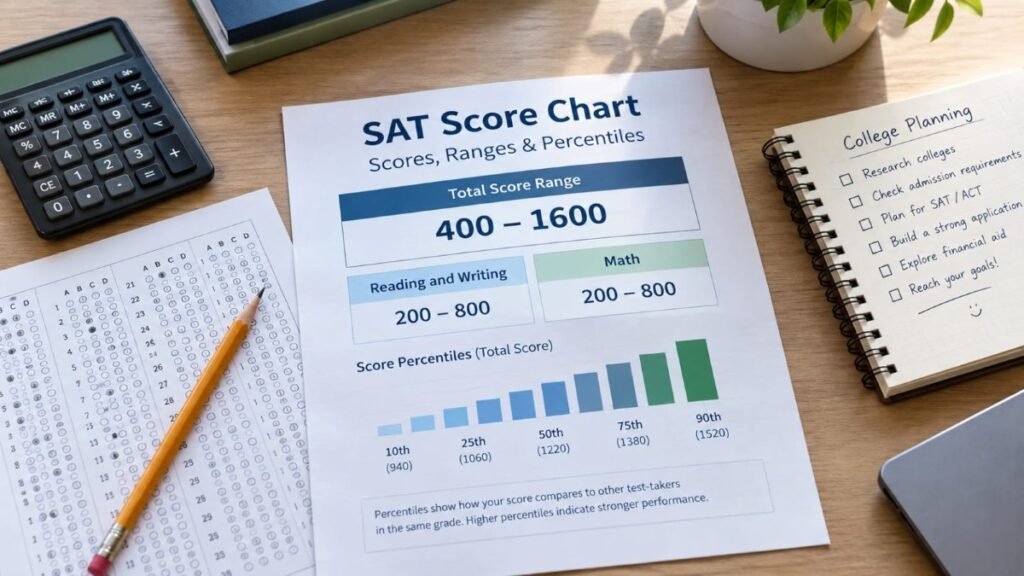
If you’re preparing for the SAT, one of the first things you may look for is an SAT score chart.
You might be wondering what a 1000, 1200, 1300, 1400, or 1500 actually means. Maybe you just finished a practice test and want to see where your score falls. Or perhaps you’re starting to build a college list and want a better idea of what SAT scores mean in the U.S. college admissions process.
The current SAT uses a 400–1600 total score scale. Your total score is made up of two section scores: Reading and Writing and Math. Each section is scored from 200 to 800.

But there’s an important detail to understand: the digital SAT is adaptive. That means you shouldn’t rely on an old online chart that simply says a certain number of correct answers always equals a certain SAT score.
In this guide, we’ll break down the current SAT score scale, explain common score ranges, look at percentiles and benchmarks, and show you how to use your score when planning for college.
SAT Score Chart: 400 to 1600
Here’s a simple reference chart for the SAT’s 400–1600 scale.
| SAT Score | General Context |
|---|---|
| 400–590 | Lower end of the SAT scale |
| 600–790 | Developing score range |
| 800–990 | Around the lower-middle range |
| 1000–1190 | Middle-range scores |
| 1200–1290 | Strong score range |
| 1300–1390 | Higher score range |
| 1400–1490 | Very high score range |
| 1500–1600 | Near the top of the SAT scale |
These descriptions are meant to provide general context, not official College Board categories.
There isn’t one SAT score that automatically counts as “good” for every student.
A score that works well for one student’s college list may be less competitive for another student’s goals. That’s why it’s more useful to look at your score alongside the colleges you’re considering.
If you want a separate explanation of score expectations, you can also read our guide to What Is a Good SAT Score?.
What Is the SAT Scoring Scale?
The current SAT has two scored sections:
- Reading and Writing
- Math
Each section has a possible score from 200 to 800.
Your total SAT score is the sum of those two scores.
| Score Type | Range |
|---|---|
| Reading and Writing | 200–800 |
| Math | 200–800 |
| Total SAT Score | 400–1600 |
For example, if your score report shows:
Reading and Writing: 640
Math: 680
Your total SAT score would be:
640 + 680 = 1320
So your total score would be 1320.
College Board’s official score information confirms that the SAT total score ranges from 400 to 1600, while each section ranges from 200 to 800.
Official College Board SAT Score Information
Because SAT scoring information can change, it’s a good idea to check the official source rather than relying only on third-party charts.
You can review College Board’s official explanation of what SAT scores mean, including score ranges, percentiles, and information shown on your official score report.
SAT Score Chart by Section
Your total SAT score is important, but your two section scores also matter.
Consider three students who all scored 1300:
| Student | Reading and Writing | Math | Total |
|---|---|---|---|
| Student A | 700 | 600 | 1300 |
| Student B | 600 | 700 | 1300 |
| Student C | 650 | 650 | 1300 |
All three students have the same total score.
However, their section profiles are different.
This can be useful information when deciding what to study next. If your Math score is much lower than your Reading and Writing score, for example, you may want to spend more of your preparation time on Math.
The same idea applies in reverse.
Looking only at your total score can hide useful information about your strengths and weaknesses.
What Does a 1000 SAT Score Mean?
A 1000 can be a useful starting point, particularly if you’re taking an early practice test.
Don’t assume that your first practice score is your final SAT score.
Instead, look at the breakdown.
For example:
- 500 Reading and Writing + 500 Math = 1000
- 450 Reading and Writing + 550 Math = 1000
- 550 Reading and Writing + 450 Math = 1000
Each student may need a different study strategy.
If you’re preparing for the SAT, your first goal should usually be understanding where you’re losing points, not simply worrying about the total number.
What Does a 1100 SAT Score Mean?
An 1100 gives you a useful baseline for SAT preparation.
If you are a junior with several months before your test date, you may have plenty of time to improve your score.
Start by reviewing the questions you missed.
Were they mostly:
- Algebra?
- Advanced Math?
- Grammar and punctuation?
- Reading comprehension?
- Data interpretation?
- Questions you rushed through?
Finding patterns is often more useful than simply taking another practice test without reviewing your mistakes.
What Does a 1200 SAT Score Mean?
A 1200 is an important score for many students.
But whether it meets your personal goal depends on your college list.
For example, a student applying to a wide range of U.S. colleges may have very different score targets from a student applying only to highly selective schools.
That’s why it makes sense to research individual colleges rather than treating 1200 as universally “good” or “bad.”
Your GPA, course selection, extracurricular activities, essays, recommendations, and other application factors can also matter depending on the school.
What Does a 1300 SAT Score Mean?
A 1300 is a higher score on the SAT’s 400–1600 scale.
If you’re currently scoring around 1300 on practice tests, your next step depends on your goals.
Some students may be satisfied with that range based on their college list. Others may want to keep preparing for a higher score.
If you want to improve, don’t automatically assume you need to study everything.
Review your missed questions and look for repeat mistakes.
You may discover that a relatively small number of topics are responsible for many of your lost points.
What Does a 1400 SAT Score Mean?
A 1400 is toward the higher end of the SAT scale.
For many students, reaching this level requires strong performance across both sections.
If you’re already scoring around 1400, your preparation may need to become more targeted.
Instead of spending hours reviewing material you already understand, focus on the questions you consistently miss.
For example, you might discover that:
- You lose points on transitions in Reading and Writing.
- You make occasional algebra mistakes.
- You rush through the final questions.
- You misread questions involving tables or graphs.
Those patterns can give you a much clearer study plan.
What Does a 1500 SAT Score Mean?
A 1500 is close to the top of the SAT’s scoring range.
At this level, students are often working on small improvements rather than rebuilding their entire preparation strategy.
Careful review becomes particularly important.
If you miss only a few questions on a practice test, examine exactly why you missed them.
Was it a knowledge gap?
A careless mistake?
A timing issue?
A question you misunderstood?
Understanding the reason matters more than simply counting the number of mistakes.
What Does a 1600 SAT Score Mean?
A 1600 is the maximum possible SAT total score.
That means:
800 Reading and Writing + 800 Math = 1600
A 1600 is the highest point on the SAT scale, but SAT scores are only one part of the college application process.
Students should still pay attention to their grades, coursework, activities, essays, recommendations, and the individual admissions policies of the colleges they’re considering.
SAT Score Chart and Percentiles
An SAT score and an SAT percentile are not the same thing.
Your SAT score is the number you receive on the 400–1600 scale.
Your percentile provides comparison with other students.
For example, if a student is in a particular percentile, that information helps show how their score compares with the relevant group of test takers.
College Board includes percentile information on official SAT score reports.
If you’ve taken the SAT more than once, check out our guide to SAT Superscore to learn how colleges may combine your highest section scores from different test dates.
If you’re interested in this comparison, our guide to SAT score percentiles goes into more detail.
Why Should Students Look at Percentiles?
Percentiles can provide useful context.
A raw score by itself doesn’t always tell you how it compares with other SAT takers.
However, percentile information shouldn’t be interpreted as an admission guarantee.
A high percentile does not automatically mean a particular college will admit you.
College admissions decisions are made by individual institutions using their own policies and processes.
SAT College and Career Readiness Benchmarks
College Board also provides SAT College and Career Readiness Benchmarks.
The current section benchmarks are:
| SAT Section | Benchmark |
|---|---|
| Reading and Writing | 480 |
| Math | 530 |
College Board explains that these benchmarks are intended to provide information about college and career readiness. They are not college admission cutoffs.
For example, meeting the Math benchmark does not mean a student automatically meets the SAT expectations of a specific university.
College admissions requirements vary by institution.
How Does the Digital SAT Calculate Scores?
This is one of the most important things to understand before using an SAT score chart.
The current digital SAT uses a multistage adaptive design.
Both Reading and Writing and Math are divided into two modules.
Your performance in the first module helps determine the difficulty level of the second module.
College Board also uses an Item Response Theory-based scoring model.
Because of this, the relationship between the number of questions answered correctly and the final scaled score isn’t simply:
Number correct × fixed number of points = SAT score
College Board explains that the scoring model considers factors such as the characteristics and difficulty of the questions answered correctly or incorrectly.
Why Old SAT Raw Score Charts Can Be Misleading
You may find old SAT charts online that look something like this:
| Correct Answers | Estimated Score |
|---|---|
| 50 | 1200 |
| 60 | 1300 |
| 70 | 1400 |
| 80 | 1500 |
The problem is that this kind of chart can give the impression that every digital SAT follows one fixed conversion.
That’s not how the current scoring system works.
Two students could answer the same number of questions correctly and receive different section scores because the scoring model takes question characteristics into account.
For that reason, use official scoring information associated with the specific practice test you’re taking instead of relying on a random raw-score chart.
How to Use an SAT Score Chart After a Practice Test
A score chart is most useful when you use it as part of a larger review process.
Step 1: Check Your Total Score
Start with your total score.
This gives you the basic 400–1600 result.
Step 2: Look at Your Section Scores
Next, check Reading and Writing and Math separately.
You may discover that one section is much stronger than the other.
Step 3: Review Your Missed Questions
Don’t stop at the score.
Go back through your incorrect answers and ask why you missed each question.
Step 4: Look for Patterns
If you repeatedly miss the same type of question, that’s probably a better place to focus your study time than randomly reviewing the entire SAT.
You can also use our SAT practice test resources to continue practicing.
Step 5: Track Your Progress
For example:
| Practice Test | Reading & Writing | Math | Total |
|---|---|---|---|
| Test 1 | 560 | 570 | 1130 |
| Test 2 | 580 | 600 | 1180 |
| Test 3 | 610 | 620 | 1230 |
| Test 4 | 630 | 640 | 1270 |
This type of progress tracking can tell you much more than a single practice-test score.
SAT Score Chart vs. SAT Score Calculator
An SAT score chart and an SAT score calculator aren’t exactly the same thing.
A chart gives you a quick visual reference for score ranges.
A calculator may estimate a score based on practice-test performance.
If you’re interested in estimating your practice performance, you can also use our SAT Score Calculator.
Just remember that an online calculator is an estimate. Your official SAT score comes from College Board’s scoring system.
What SAT Score Should You Aim For?
There isn’t one universal target score that every U.S. student should aim for.
A better approach is to start with your college list.
Check each college’s current testing policy and look at the SAT information it publishes.
Then ask yourself:
- Where am I scoring right now?
- What scores are reported by the colleges I’m considering?
- How much time do I have before my SAT?
- Which section needs the most work?
- Would taking the SAT again make sense for my goals?
This makes your target more meaningful than simply choosing an arbitrary number.
What If Your SAT Score Is Lower Than You Expected?
Don’t panic after one practice test.
A practice test is a snapshot of your performance on that particular day.
Instead, look at the details.
If your Math score is lower than expected, review your Math mistakes.
If Reading and Writing is the weaker section, identify which question types are causing problems.
Also consider timing.
Sometimes a student understands the material but loses points because they rush through the last part of a module.
The goal is to turn your score into useful information.
What If Your SAT Score Is Already High?
Students who are already scoring well may need a different approach.
If you’re scoring around 1400 or higher, taking more and more full-length tests without reviewing them may not be the most useful way to spend your time.
Look closely at the questions you miss.
Try to determine whether each mistake came from:
- Content knowledge
- Misreading
- Timing
- Calculation
- Guessing
- Carelessness
Once you understand the pattern, you can make your preparation more targeted.
SAT Score Chart: Quick Reference
Here’s a simple reference you can save.
| SAT Score | General Context |
|---|---|
| 400 | Lowest possible SAT total |
| 500 | Lower portion of the scale |
| 600 | Developing range |
| 700 | Below the midpoint |
| 800 | Midpoint of the total scale |
| 900 | Lower-middle range |
| 1000 | Around the middle of the scale |
| 1100 | Solid starting point for many students |
| 1200 | Stronger overall performance |
| 1300 | Higher score range |
| 1400 | Very high score |
| 1500 | Near the top of the scale |
| 1600 | Maximum possible score |
Again, these are general descriptions for easier understanding. They are not official College Board score classifications.
Frequently Asked Questions About the SAT Score Chart
What is the SAT score range?
The current SAT total score ranges from 400 to 1600. Reading and Writing and Math are each scored from 200 to 800.
What is the highest SAT score?
The highest possible SAT score is 1600, made up of 800 in Reading and Writing and 800 in Math.
What is the lowest SAT score?
The lowest possible total SAT score is 400.
Is 1200 a good SAT score?
A 1200 can be a useful score depending on a student’s college list and goals. There isn’t one score that is universally considered good for every student.
Is 1400 a good SAT score?
A 1400 is toward the higher end of the SAT’s 400–1600 scale. Students should compare it with the current testing policies and published score information of their target colleges.
How is the SAT score calculated?
The total SAT score is the sum of the Reading and Writing and Math section scores. The digital SAT uses a multistage adaptive design and an Item Response Theory-based scoring model.
Can I use an old SAT raw score chart?
Be careful with older charts. The current digital SAT uses an adaptive scoring system, so a simple universal raw-score conversion may not accurately represent your official score.
What are the SAT section score ranges?
Both Reading and Writing and Math are scored from 200 to 800.
What are SAT percentiles?
Percentiles show how a student’s score compares with other SAT test takers in the relevant comparison group. College Board includes percentile information in official score reports.
Can an SAT score chart predict college admission?
No. A score chart explains the SAT scoring scale. It cannot predict whether a particular college will admit a student.
Final Thoughts
An SAT Score Chart can be a helpful starting point when you’re trying to understand your SAT results.
The current SAT uses a 400–1600 scale, with Reading and Writing and Math each scored from 200–800. But the digital SAT’s adaptive scoring system means that you shouldn’t rely on a simple “questions correct = exact score” formula.
If you’ve just taken a practice test, look beyond the total number.
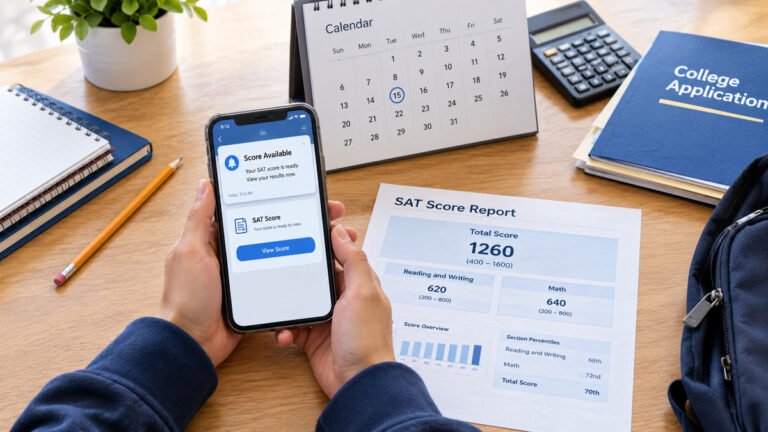
Once you take the actual SAT, you may also want to know when your results will be available. Our guide to SAT Score Release Dates 2026 explains the expected score-release schedule and what to know before checking your results.”
Check your section scores. Review the questions you missed. Look for patterns. Compare your progress across multiple practice tests.
And when you’re thinking about college, use your actual college list as the context for your SAT score.
The goal isn’t simply to chase a number. It’s to understand where you are now, where you want to go, and what your score means for the colleges you’re considering.


1 Comment
[…] can use our SAT Score Chart to understand the score scale, and our What Is a Good SAT Score? guide for additional […]