

Preparing for the Digital SAT Reading and Writing section requires more than knowing English vocabulary. Students also need to understand how sentences work, recognize grammatical errors, and choose punctuation that makes a passage clear. Learning the most important SAT Grammar Rules can help students answer these questions more accurately and avoid common mistakes. Topics such as Subject-Verb Agreement, SAT Grammar Practice, and SAT Punctuation Rules are especially important because they help students understand how correct English sentences are formed.
The Digital SAT tests grammar through short passages with questions about sentence structure, word usage, and punctuation. You do not need to memorize every grammar rule in the English language. Instead, focus on the conventions tested on the SAT, learn how to recognize them in context, and practice applying them to realistic questions.
This guide explains the major grammar concepts you should know, provides original SAT-style examples, and includes practice questions with answers and explanations to help you prepare.
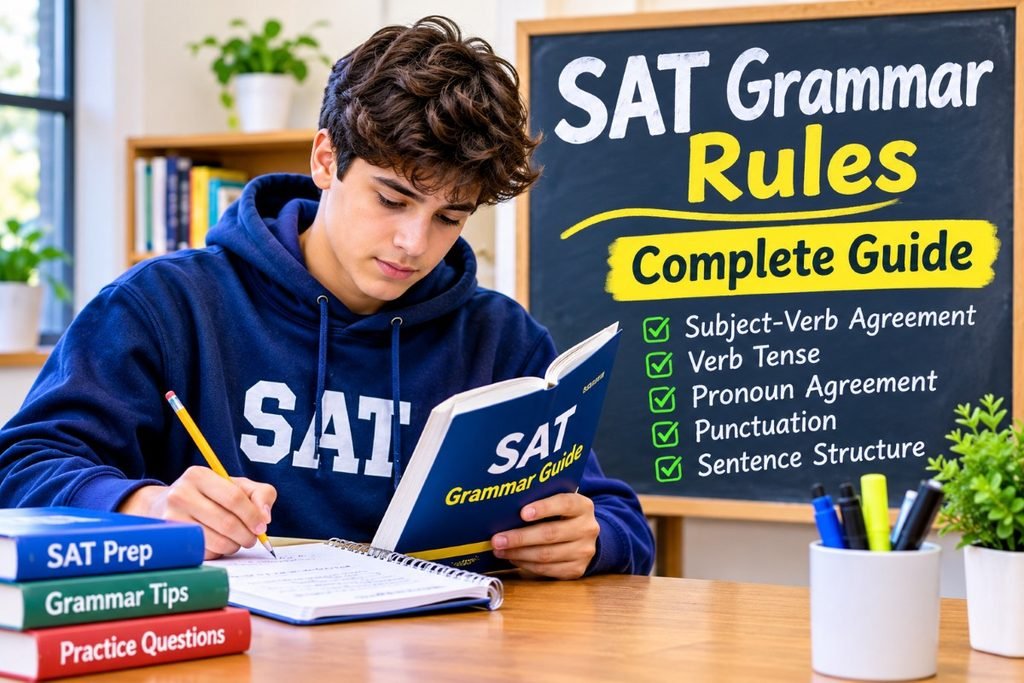
What Grammar Rules Are Tested on the SAT?
The SAT does not have a separate grammar section. Grammar questions appear in the Reading and Writing section under a content domain called Standard English Conventions.
The College Board divides this domain into two main skill areas:
- Boundaries: How sentences, clauses, and punctuation marks work together.
- Form, Structure, and Sense: How words and phrases are used to create grammatically correct sentences.
Standard English Conventions account for approximately 26% of the Reading and Writing section’s operational questions, or about 11–15 questions. This makes grammar an important part of your SAT preparation.
You can learn more about the SAT Reading and Writing section and how it fits into the Digital SAT format.
For the official breakdown of tested skills, visit the College Board’s SAT Reading and Writing overview.
1. Subject-Verb Agreement
Subject-verb agreement is one of the most important SAT grammar rules. A verb must agree with its subject in number.
A singular subject generally takes a singular verb, while a plural subject takes a plural verb.
Examples:
- Correct: The student studies every evening.
- Incorrect: The student study every evening.
- Correct: The students study every evening.
- Incorrect: The students studies every evening.
Watch Out for Words Between the Subject and Verb
The SAT may place extra information between a subject and its verb to make the sentence more challenging. Do not let these additional words distract you.
Example:
The collection of historical documents ___ several rare letters.
A. (contain)
B. (contains)
C. (containing)
D. (have contained)
Correct answer: B. (contains)
The subject is “collection,” which is singular. The phrase “of historical documents” describes the collection but does not change the subject.
Subjects Joined by “And” or “Or”
Two subjects joined by “and” usually take a plural verb.
Example:
The teacher and the counselor are meeting with the students.
When subjects are joined by “or” or “nor,” the verb generally agrees with the subject closest to it.
Examples:
Neither the students nor the teacher is available.
Neither the teacher nor the students are available.
SAT tip: Find the actual subject before selecting a verb. Do not automatically match the verb with the nearest noun.
2. Verb Tense and Verb Forms
Verb tense shows when an action happens. The SAT tests whether verb forms fit the timeline and meaning of a sentence.
The most common verb forms include:
| Verb tense | Example |
|---|---|
| Simple present | She studies biology. |
| Simple past | She studied biology. |
| Simple future | She will study biology. |
| Present perfect | She has studied biology. |
| Past perfect | She had studied biology. |
| Present progressive | She is studying biology. |
Maintain Consistent Verb Tense
When a sentence describes events occurring within the same time frame, its verbs should generally use consistent tenses.
Example:
The researcher collected the samples and ___ them in a laboratory.
A. (analyzes)
B. (analyzed)
C. (analyzing)
D. (has analyzed)
Correct answer: B. (analyzed)
The first verb, “collected,” is in the simple past tense. The second verb should also be in the past tense.
Understand the Difference Between Past and Present Perfect
The present perfect often describes an action that began in the past and continues into the present or has a present connection.
Example:
The scientist has published several research papers.
The simple past is generally used for a completed action at a specific time.
Example:
The scientist published the paper last year.
SAT tip: Look for time expressions such as “yesterday,” “last year,” “since,” and “for.” They can help you identify the appropriate tense.
3. Pronoun Agreement and Clarity
A pronoun replaces a noun to avoid unnecessary repetition. Pronouns should agree with their antecedents and clearly refer to the intended person, place, or thing.
An antecedent is the noun that a pronoun refers to.
Example:
The students submitted their assignments before the deadline.
“Students” is the antecedent of “their.”
Singular and Plural Pronouns
A singular noun generally takes a singular pronoun, while a plural noun generally takes a plural pronoun.
Incorrect: The students submitted his assignment.
Correct: The students submitted their assignments.
Pronoun Clarity
A pronoun should have a clear reference. If a sentence contains multiple possible antecedents, the reader may not know which noun the pronoun represents.
Example:
After the historian interviewed the professor, she published the findings.
The pronoun “she” could refer to either the historian or the professor. A clearer sentence would identify the person who published the findings.
SAT tip: When answer choices use different pronouns, check which noun each pronoun refers to. Choose the option that makes the sentence clear and grammatically correct.
4. Sentence Boundaries: Fragments, Run-Ons, and Comma Splices
Sentence boundaries are a major part of the SAT’s Standard English Conventions domain.
You need to recognize complete sentences and understand how independent and dependent clauses connect.
Independent Clauses
An independent clause contains a subject and a verb and expresses a complete thought.
Example:
The experiment produced unexpected results.
This is a complete sentence.
Dependent Clauses
A dependent clause contains a subject and a verb but does not express a complete thought on its own.
Example:
Although the experiment produced unexpected results
This is incomplete because the word “although” makes the clause dependent.
A complete version would be:
Although the experiment produced unexpected results, the researchers continued their work.
Sentence Fragments
A sentence fragment is an incomplete sentence presented as if it were a complete one.
Incorrect: Because the laboratory was closed.
Correct: Because the laboratory was closed, the researchers postponed the experiment.
Run-On Sentences
A run-on sentence occurs when two independent clauses are incorrectly joined without appropriate punctuation or a conjunction.
Incorrect: The library closed early the students continued studying outside.
Correct: The library closed early, but the students continued studying outside.
Comma Splices
A comma splice occurs when two independent clauses are connected using only a comma.
Incorrect: The study was successful, the researchers published their findings.
Correct: The study was successful, and the researchers published their findings.
Another correct option:
The study was successful; the researchers published their findings.
SAT tip: When you see a comma or semicolon in the answer choices, check whether the sentence contains one independent clause or two. This often helps you eliminate incorrect options quickly.
5. SAT Punctuation Rules
Punctuation questions test whether you understand how different marks connect ideas and separate sentence elements.
The most important punctuation marks to study are commas, semicolons, colons, dashes, and apostrophes.
Comma Rules
Commas have several uses in standard English.
Use 1: Separate items in a series.
The course covers biology, chemistry, physics, and environmental science.
Use 2: Introduce an independent clause after an introductory dependent clause.
Although the results were unexpected, the researchers continued the experiment.
Use 3: Set off nonessential information.
Marie Curie, who studied radioactivity, won two Nobel Prizes.
The phrase “who studied radioactivity” adds information but is not necessary to identify Marie Curie.
Use 4: Separate two independent clauses joined by a coordinating conjunction.
The weather was cold, but the students continued their outdoor experiment.
Semicolon Rules
A semicolon can connect two closely related independent clauses without a coordinating conjunction.
Example:
The evidence was convincing; the committee approved the proposal.
Both sides of the semicolon can stand alone as complete sentences.
A semicolon can also separate items in a complex list when those items already contain commas.
Example:
The conference included speakers from Austin, Texas; Denver, Colorado; and Portland, Oregon.
Remember: A semicolon should not normally separate an independent clause from a dependent clause.
Colon Rules
A colon can introduce an explanation, example, or list after an independent clause.
Example:
The researcher needed three materials: a microscope, a notebook, and a measuring tool.
The words before the colon form a complete sentence.
Incorrect: The researcher needed: a microscope, a notebook, and a measuring tool.
The phrase before the colon is not a complete independent clause.
Dash Rules
A pair of dashes can set off nonessential information within a sentence.
Example:
The discovery—which changed how scientists understood the process—received international attention.
A single dash can introduce an explanation or emphasize additional information.
Example:
The team reached its goal—the completion of the research project.
Apostrophe Rules
Apostrophes show possession or form contractions.
Possession:
- The student’s notebook
- The researchers’ findings
- The children’s classroom
Contractions:
- It is = It’s
- They are = They’re
- Do not = Don’t
Be careful with the difference between “its” and “it’s.”
- Its shows possession.
- It’s means “it is” or “it has.”
Example:
The laboratory updated its safety procedures.
It’s important to follow the laboratory’s safety procedures.
SAT tip: Learn what each punctuation mark does rather than memorizing isolated examples. On the SAT, punctuation choices depend on the structure of the entire sentence.
6. Modifier Placement
A modifier is a word or phrase that describes another part of a sentence.
A modifier should be placed close enough to the word it describes to make the meaning clear.
Misplaced Modifiers
Incorrect:
The researcher examined the samples using a microscope that were collected yesterday.
The placement makes the sentence awkward because the modifier does not clearly connect to the intended noun.
Clearer:
The researcher examined the samples that were collected yesterday using a microscope.
Dangling Modifiers
A dangling modifier does not clearly describe the subject of the sentence.
Incorrect:
Walking through the museum, the ancient paintings impressed the students.
This sentence incorrectly suggests that the paintings were walking through the museum.
Correct:
Walking through the museum, the students admired the ancient paintings.
The introductory phrase now correctly describes the students.
SAT tip: When an answer choice changes the beginning of a sentence, check whether the opening modifier logically describes the subject that follows it.
7. Parallel Structure
Parallel structure means using the same grammatical form for related words, phrases, or ideas.
It makes sentences easier to read and understand.
Incorrect:
The course teaches students to analyze evidence, writing arguments, and evaluate sources.
Correct:
The course teaches students to analyze evidence, write arguments, and evaluate sources.
The three actions use the same grammatical form.
Parallel Structure in Lists
Incorrect:
The research project requires collecting data, analyzing results, and a written report.
Correct:
The research project requires collecting data, analyzing results, and writing a report.
Parallel Structure in Comparisons
Related ideas in comparisons should also use matching grammatical structures.
Example:
The new system is more efficient than the previous system was.
SAT tip: Look for lists joined by words such as “and,” “or,” and “but.” Check whether the connected elements follow the same grammatical pattern.
8. Subject, Object, and Possessive Forms
The SAT may test whether a pronoun is being used correctly based on its role in a sentence.
The three common pronoun categories are:
| Form | Examples |
|---|---|
| Subject | I, he, she, we, they |
| Object | me, him, her, us, them |
| Possessive | my, his, her, our, their |
Example:
The teacher gave the research assignment to Maya and ___.
A. (I)
B. (me)
C. (my)
D. (mine)
Correct answer: B. (me)
The pronoun is the object of the preposition “to,” so the object form is required.
Another example:
Maya and ___ completed the research assignment.
A. (me)
B. (I)
C. (mine)
D. (myself)
Correct answer: B. (I)
The pronoun is part of the subject, so the subject form is correct.
SAT tip: Remove the other person from the sentence temporarily. For example, “The teacher gave the assignment to me” makes the correct pronoun easier to identify.
9. Noun Forms and Possessives
Nouns can be singular, plural, or possessive. The correct form depends on the meaning and grammatical role of the word.
Examples:
- Student: one student
- Students: more than one student
- Student’s: something belonging to one student
- Students’: something belonging to multiple students
Example:
The ___ research was presented at the science conference.
A. (students)
B. (student’s)
C. (students’)
D. (student)
If the research belongs to several students, the correct answer is C, “(students’).”
SAT tip: Determine whether the sentence describes ownership, quantity, or simply names a person or thing before selecting a noun form.
10. Logical Comparisons
A comparison should connect two things that can logically be compared.
Incorrect:
The population of Chicago is larger than New York.
This compares a population with a city.
Correct:
The population of Chicago is larger than the population of New York.
The comparison now connects two populations.
Another example:
The new research method is more accurate than the previous method.
SAT tip: Make sure the two things being compared belong to the same category. Watch for sentences that compare a person with a group, an object with an idea, or a measurement with a location.
How to Approach SAT Grammar Questions
Knowing grammar rules is important, but you also need a reliable way to apply them under time pressure.
Use this process when answering grammar questions.
Step 1: Read the Complete Sentence
Do not focus only on the blank. Read the entire sentence so you understand its meaning and structure.
Step 2: Identify the Grammar Rule
Ask yourself what the question is testing.
Is it about:
- Subject-verb agreement?
- Verb tense?
- Pronoun agreement?
- Punctuation?
- Sentence boundaries?
- Modifier placement?
- Parallel structure?
Identifying the rule helps narrow down your choices.
Step 3: Check the Sentence Structure
Find the subject, verb, and clauses. Determine whether the sentence contains one independent clause or multiple clauses.
This is especially helpful for comma, semicolon, and colon questions.
Step 4: Eliminate Incorrect Answers
Remove choices that create fragments, run-on sentences, incorrect verb forms, or unclear meanings.
You do not always need to know immediately which answer is correct. Eliminating clearly incorrect choices can make the decision easier.
Step 5: Read Your Selected Answer in Context
Read the complete sentence again with your selected answer. Check that the grammar, punctuation, and meaning all work together.
SAT Grammar Practice: 10 Practice Questions
The following questions are original practice examples created for this guide. They are not official College Board questions, but they cover grammar skills relevant to the Digital SAT.
Try answering each question before checking the explanations.
Question 1: Subject-Verb Agreement
The collection of scientific articles ___ information about climate change.
A. (provide)
B. (provides)
C. (providing)
D. (have provided)
Correct answer: B. (provides)
Explanation: The subject is “collection,” which is singular. The phrase “of scientific articles” does not change the subject. Therefore, the singular verb “provides” is correct.
Question 2: Verb Tense
Last summer, the research team ___ several experiments to study plant growth.
A. (conducts)
B. (conducting)
C. (conducted)
D. (has conducted)
Correct answer: C. (conducted)
Explanation: “Last summer” identifies a completed action in the past. The simple past tense is required.
Question 3: Pronoun Agreement
The students reviewed their notes before ___ began the examination.
A. (they)
B. (them)
C. (their)
D. (theirs)
Correct answer: A. (they)
Explanation: The pronoun is the subject of the verb “began.” Therefore, “they” is the correct subject pronoun.
Question 4: Comma Usage
Although the experiment produced unexpected results ___ the researchers continued their investigation.
A. (,)
B. (;)
C. (:)
D. no punctuation
Correct answer: A.(,)
Explanation: The sentence begins with a dependent clause introduced by “although.” A comma separates that introductory clause from the independent clause.
Question 5: Semicolon Usage
The museum recently expanded its collection ___ several rare artifacts were added to the new exhibition.
A. (,)
B. (;)
C. (because)
D. (although)
Correct answer: B. (;)
Explanation: Both sides of the blank are independent clauses. A semicolon can correctly connect two closely related independent clauses.
Question 6: Sentence Boundaries
The professor explained the scientific method ___ the students then completed a laboratory activity.
A.
B. (,)
C. (;)
D. (because)
Correct answer: C. (;)
Explanation: Both parts are independent clauses. A semicolon correctly connects them without creating a comma splice or run-on sentence.
Question 7: Modifier Placement
___, the students carefully examined the historical documents.
A. (While visiting the archive)
B. (The historical documents)
C. (The archive was open)
D. (After the documents)
Correct answer: A. (While visiting the archive)
Explanation: The introductory phrase should describe the subject of the sentence. The students were visiting the archive, so A is correct.
Question 8: Parallel Structure
The science program encourages students to observe experiments, record results, and ___ conclusions.
A. (drawing)
B. (drew)
C. (draw)
D. (drawn)
Correct answer: C. (draw)
Explanation: The sentence uses three actions in a parallel structure: observe, record, and draw. All three verbs should have the same grammatical form.
Question 9: Apostrophe Usage
The ___ presentations were displayed at the school science fair.
A. (students)
B. (student’s)
C. (students’)
D. (student)
Correct answer: C. (students’)
Explanation: The presentations belong to multiple students. The plural possessive form is “students’.”
Question 10: Logical Comparison
The accuracy of the new instrument is greater than ___.
A. (the previous instrument)
B. (the previous instrument’s accuracy)
C. (the previous instrument was)
D. (the previous instrument measuring)
Correct answer: B. (the previous instrument’s accuracy)
Explanation: The sentence compares the accuracy of one instrument with the accuracy of another. Both sides of the comparison refer to the same type of measurement.
Common SAT Grammar Mistakes to Avoid
Even students who understand English grammar can lose points by overlooking small details.
Here are some mistakes to watch for:
- Choosing a verb based on the nearest noun: Always identify the actual subject before selecting a verb.
- Using a comma to connect two complete sentences: A comma alone usually creates a comma splice.
- Confusing its and it’s: Remember that “its” shows possession, while “it’s” means “it is” or “it has.”
- Ignoring introductory modifiers: Check whether the opening phrase logically describes the subject that follows.
- Using inconsistent verb tenses: Pay attention to the timeline of the sentence.
- Choosing unnecessarily complicated answers: The best answer is the one that follows standard grammar and preserves the intended meaning.
- Ignoring the full sentence: A choice may look correct by itself but fail when placed in the complete passage.
Reviewing these mistakes after practice can help you identify patterns in your errors and improve your accuracy.
How to Improve Your SAT Grammar Skills
Learning grammar rules is only the first part of preparation. You also need regular practice and a method for reviewing mistakes.
Study One Grammar Topic at a Time
Avoid trying to memorize every rule in one sitting. Start with subject-verb agreement and sentence boundaries, then move to punctuation, pronouns, verb forms, and modifiers.
Understanding one concept thoroughly is more useful than quickly reading through a long list of rules.
For broader preparation advice, see our SAT prep study guide.
Practice with Digital SAT-Style Questions
The Digital SAT uses short passages with one question per passage. Practice identifying the grammar issue within the context of a complete passage rather than relying only on isolated sentences.
You can use our SAT practice questions to build your preparation routine.
Use Official College Board Practice Resources
The College Board provides official practice questions and full-length digital practice tests. Its Student Question Bank allows students to filter Reading and Writing questions by domain, skill, and difficulty.
Visit the official Student Question Bank for Reading and Writing to find questions related to Standard English Conventions.
You can also explore our guide to the Bluebook College Board testing app and the College Board’s official SAT practice and preparation resources.
Keep an Error Log
After each practice session, write down:
- The question you answered incorrectly.
- The grammar rule involved.
- Why your selected answer was wrong.
- Why the correct answer works.
- What you should look for next time.
For example, if you repeatedly miss semicolon questions, spend more time reviewing independent clauses and sentence boundaries.
Review Your Progress Regularly
Take a practice test after studying several grammar topics. Review your results and identify which skills still need improvement.
Use a realistic SAT practice test to check your progress.
You can also use our SAT study plans and SAT tips guide to organize your preparation.
SAT Grammar Rules: Frequently Asked Questions
1. What grammar rules are most important for the SAT?
Some of the most important topics include subject-verb agreement, verb tense, pronoun agreement, sentence boundaries, punctuation, modifier placement, and parallel structure. These concepts fall under the Standard English Conventions domain.
2. How many grammar questions are on the Digital SAT?
The College Board does not publish a fixed number of grammar questions for every test. Standard English Conventions accounts for approximately 26% of the Reading and Writing section’s operational questions, generally around 11–15 questions.
3. Does the SAT test punctuation rules?
Yes. The SAT tests punctuation through its Boundaries skill. Students should understand how commas, semicolons, colons, dashes, and other punctuation marks work in complete sentences.
4. Is subject-verb agreement important for the SAT?
Yes. Subject-verb agreement is part of the Form, Structure, and Sense skill area. You should be able to identify the subject of a sentence and choose the correct verb form, even when extra words appear between them.
5. How can I practice SAT grammar?
Start by learning one rule at a time, then answer questions that test that specific concept. Use official College Board practice resources, review every incorrect answer, and keep an error log to track recurring mistakes.
6. Is SAT grammar difficult?
SAT grammar can be challenging because questions often place extra phrases, clauses, or unfamiliar vocabulary around the grammatical issue. However, learning the core rules and practicing them in context can make these questions easier to understand.
7. Should I memorize all English grammar rules for the SAT?
No. Focus on the grammar, sentence structure, and punctuation conventions tested in the SAT’s Standard English Conventions domain. Understanding how to apply these rules in context is more useful than memorizing unrelated grammar concepts.
Final Thoughts
Learning SAT grammar rules can make a meaningful difference in your Reading and Writing preparation. Focus on the fundamentals first, especially subject-verb agreement, verb tense, sentence boundaries, punctuation, pronoun agreement, and parallel structure.
Do not limit your preparation to memorizing definitions. Practice applying each rule in complete sentences, review your mistakes, and learn why the correct answer works. Combine focused grammar exercises with official College Board practice questions to build accuracy and confidence.
With consistent preparation and a clear understanding of Standard English Conventions, you can approach SAT grammar questions more confidently and make better use of your time on test day.


No Comments