

Preparing for the SAT does not mean memorizing hundreds of difficult English words. What matters more is understanding how words work in sentences and choosing the meaning that best fits the context.
This SAT vocab practice test includes 30 original multiple-choice questions, an answer key, detailed explanations, vocabulary-building strategies, and a score guide. Use it to identify your strengths, discover common mistakes, and improve your Digital SAT Reading and Writing skills.
The questions cover academic vocabulary, context clues, precise word choice, and sentence logic. All 30 questions are original practice material created for this guide. They are not official College Board questions and do not reproduce actual SAT questions.
How SAT Vocabulary Is Tested
The Digital SAT does not rely on a fixed list of difficult words that every student must memorize. Instead, vocabulary-related questions test whether you can determine what a word means in context or select the word or phrase that most logically and precisely completes a text.
Words in Context is part of the Craft and Structure domain of SAT Reading and Writing. This domain also includes Text Structure and Purpose and Cross-Text Connections, so the domain’s overall test share should not be confused with the percentage devoted to vocabulary alone.
For a broader overview of the exam format, see our Digital SAT Updates guide.
A vocabulary question might ask you to interpret a word in a sentence. Another might require you to select the most precise word to complete a short passage.
Consider this example:
The researcher repeated the experiment to _____ the original findings.
Which word best completes the sentence?
- A. Contradict
- B. Substantiate
- C. Postpone
- D. Simplify
Correct answer: B. Substantiate
To substantiate something means to support it with evidence. The researcher repeats the experiment to check or support the earlier findings.
The sentence itself provides the clue. You do not need to guess based only on how sophisticated a word sounds.
That is the central idea behind effective SAT vocabulary practice: understand the sentence first, then choose the word that fits its meaning.
Before You Start This SAT Vocab Practice Test
Set aside approximately 15–20 minutes for the 30 questions. If you are still learning the vocabulary, take your time. Once your accuracy improves, try completing the questions more quickly.
Follow these steps:
- Read the entire sentence before looking closely at the answer choices.
- Identify the main idea and any contrast, cause-and-effect, or explanatory clues.
- Predict the meaning the sentence requires.
- Compare your prediction with the choices.
- Select the most precise answer.
- Mark difficult questions for review rather than immediately looking up the word.
The three difficulty levels below are informal practice categories, not official College Board classifications.
SAT Vocab Practice Test: 30 Questions

Part 1: Easy Questions (1–10)
These questions focus on common academic vocabulary and straightforward context clues.
Question 1: Pragmatic
The city chose a pragmatic solution to the parking shortage: instead of constructing an expensive garage, it converted an unused lot into temporary parking.
What does pragmatic most nearly mean?
A. Imaginative
B. Practical
C. Controversial
D. Permanent
Question 2: Anomalous
The first experiment produced an anomalous result. Every other trial showed increased plant growth, but this one showed an unexpected decline.
What does anomalous most nearly mean?
A. Unusual
B. Predictable
C. Successful
D. Incomplete
Question 3: Meticulous
The historian’s research was meticulous. She checked every date against several archival records before including it in her book.
What does meticulous most nearly mean?
A. Creative
B. Careful and detailed
C. Uncertain
D. Unusually quick
Question 4: Mitigate
The school introduced staggered dismissal times to mitigate the traffic congestion that occurred each afternoon.
What does mitigate most nearly mean?
A. Measure
B. Reduce
C. Predict
D. Document
Question 5: Candid
When asked whether the project would succeed, the director gave a candid response and admitted that several problems remained unresolved.
What does candid most nearly mean?
A. Humorous
B. Indirect
C. Honest and direct
D. Highly formal
Question 6: Resilient
The desert plant is remarkably resilient. Even after months without rain, it can recover when water becomes available again.
What does resilient most nearly mean?
A. Difficult to identify
B. Able to recover
C. Dependent on shade
D. Unusually large
Question 7: Subsequent
The policy was criticized when it was first announced. Subsequent surveys, however, showed that most residents had come to support it.
What does subsequent most nearly mean?
A. Unrelated
B. Earlier
C. Later
D. Occasional
Question 8: Novel
The architect proposed a novel design that replaced several traditional materials with a lightweight composite.
What does novel most nearly mean?
A. Inexpensive
B. Familiar
C. New or original
D. Unfinished
Question 9: Refine
After reviewing the first draft, the editor asked the author to refine the argument by replacing vague claims with more specific evidence.
What does refine most nearly mean?
A. Improve or make more precise
B. Remove completely
C. Summarize briefly
D. Question publicly
Question 10: Preliminary
The researchers described their findings as preliminary, emphasizing that additional testing was necessary before they could reach a firm conclusion.
What does preliminary most nearly mean?
A. Final
B. Early and not yet complete
C. Widely accepted
D. Unrelated
Part 2: Medium Questions (11–20)
These questions require closer attention to the relationships between ideas and the exact meanings of academic words.
Question 11: Substantiate
The researchers collected additional data to substantiate their original claim that the treatment improved recovery times.
What does substantiate most nearly mean?
A. Challenge
B. Replace
C. Support with evidence
D. Simplify
Question 12: Tentative
Because the study included only twelve participants, the scientist remained tentative about its conclusions and recommended further investigation.
What does tentative most nearly mean?
A. Uncertain
B. Enthusiastic
C. Permanent
D. Detailed
Question 13: Illuminate
The historian used newly discovered letters to illuminate the motivations behind a political decision that had puzzled researchers for decades.
What does illuminate most nearly mean?
A. Decorate
B. Clarify
C. Shorten
D. Challenge
Question 14: Corroborate
Two independent studies corroborated one another: despite using different methods, both reached nearly identical conclusions.
What does corroborated most nearly mean?
A. Contradicted
B. Supported or confirmed
C. Replaced
D. Delayed
Question 15: Temper
After the team won by a narrow margin against a much weaker opponent, the coach decided to temper his praise.
What does temper most nearly mean?
A. Intensify
B. Moderate
C. Repeat
D. Publish
Question 16: Ambiguous
The contract contained an ambiguous clause that both parties interpreted differently, leading to a dispute over their responsibilities.
What does ambiguous most nearly mean?
A. Legally binding
B. Difficult to pronounce
C. Open to more than one interpretation
D. Clearly explained
Question 17: Concede
Although the mayor initially defended the proposal, she eventually conceded that its projected costs had been underestimated.
What does conceded most nearly mean?
A. Acknowledged that something was true
B. Refused to discuss the issue
C. Introduced a new proposal
D. Delayed the decision
Question 18: Discrepancy
The accountant noticed a discrepancy between the amount recorded in the ledger and the amount deposited in the bank.
What does discrepancy most nearly mean?
A. A confirmed agreement
B. A minor expense
C. A financial prediction
D. A difference or inconsistency
Question 19: Detrimental
The report concluded that prolonged exposure to the chemical could have detrimental effects on aquatic organisms.
What does detrimental most nearly mean?
A. Beneficial
B. Harmful
C. Temporary
D. Unpredictable
Question 20: Plausible
The scientist proposed a plausible explanation for the unexpected results, although additional experiments would be needed to establish whether it was correct.
What does plausible most nearly mean?
A. Impossible to verify
B. Widely accepted as fact
C. Reasonable or believable
D. Completely original
Part 3: Challenging Questions (21–30)
These questions use more nuanced vocabulary and require you to consider the author’s reasoning, surrounding evidence, or the precision of a word.
Question 21: Mitigate vs. Eliminate
The new drainage system was designed to mitigate flooding during severe storms. Although water still entered some streets, the system substantially reduced the depth and duration of the flooding.
Which interpretation of mitigate best fits the passage?
A. Prevent an event from ever occurring
B. Make a problem less severe
C. Predict when a problem will occur
D. Identify the original cause of a problem
Question 22: Equivocal
Asked whether the university would adopt the proposed policy, the spokesperson gave an equivocal response, neither confirming nor rejecting the plan.
What does equivocal most nearly mean?
A. Firm and decisive
B. Enthusiastic and supportive
C. Ambiguous or open to multiple interpretations
D. Entirely unrelated
Question 23: Subtle
The difference between the two theories was subtle: both explained the same observations, but one relied on a slightly different assumption about how the process began.
What does subtle most nearly mean?
A. Not immediately obvious
B. Completely incorrect
C. Dramatic and unmistakable
D. Easy to measure
Question 24: Inhibit
The presence of certain compounds can inhibit bacterial growth, allowing researchers to observe how the organisms respond to different environmental conditions.
What does inhibit most nearly mean?
A. Accelerate
B. Restrict or slow
C. Measure precisely
D. Explain fully
Question 25: Qualify
The researcher supported the theory but qualified her endorsement by noting that the available evidence came from a relatively small sample.
What does qualified most nearly mean?
A. Certified someone for a position
B. Rejected the theory completely
C. Explained that the support had limitations
D. Declared the evidence conclusive
Question 26: Efficacy
The clinical team evaluated the efficacy of the new treatment by comparing patient outcomes with those of a control group.
What does efficacy most nearly mean?
A. Cost of implementation
B. Degree of public acceptance
C. Likelihood of producing side effects
D. Ability to produce the intended result
Question 27: Bolster
To bolster her argument, the author included additional survey results and compared them with findings from an independent study.
What does bolster most nearly mean?
A. Strengthen or support
B. Weaken deliberately
C. Summarize briefly
D. Question indirectly
Question 28: Divergent
Although both research teams investigated the same phenomenon, their conclusions were divergent because they interpreted the evidence differently.
What does divergent most nearly mean?
A. Identical
B. Mutually supportive
C. Different or moving in different directions
D. Incomplete but consistent
Question 29: Pragmatic vs. Idealistic
The committee considered an ambitious proposal to replace every school bus with an electric vehicle. Because the district’s charging infrastructure was limited, members recommended a gradual transition that could be implemented with the resources currently available.
Which word best describes the committee’s approach?
A. Impulsive
B. Pragmatic
C. Arbitrary
D. Idealistic
Question 30: Precise Word Choice
The initial findings appeared promising, but the authors refused to _____ the results because the sample was small and the study had not yet been independently replicated.
Which word most logically completes the sentence?
A. Exaggerate
B. Conceal
C. Duplicate
D. Illustrate
SAT Vocab Practice Test Answer Key
Complete all 30 questions before checking your answers. For each missed question, identify the clue in the sentence that points toward the correct meaning.
| Question | Answer | Vocabulary word |
|---|---|---|
| 1 | B | Pragmatic |
| 2 | A | Anomalous |
| 3 | B | Meticulous |
| 4 | B | Mitigate |
| 5 | C | Candid |
| 6 | B | Resilient |
| 7 | C | Subsequent |
| 8 | C | Novel |
| 9 | A | Refine |
| 10 | B | Preliminary |
| 11 | C | Substantiate |
| 12 | A | Tentative |
| 13 | B | Illuminate |
| 14 | B | Corroborate |
| 15 | B | Temper |
| 16 | C | Ambiguous |
| 17 | A | Concede |
| 18 | D | Discrepancy |
| 19 | B | Detrimental |
| 20 | C | Plausible |
| 21 | B | Mitigate |
| 22 | C | Equivocal |
| 23 | A | Subtle |
| 24 | B | Inhibit |
| 25 | C | Qualify |
| 26 | D | Efficacy |
| 27 | A | Bolster |
| 28 | C | Divergent |
| 29 | B | Pragmatic |
| 30 | A | Exaggerate |
Detailed SAT Vocabulary Answer Explanations
1. Pragmatic — B. Practical
The city uses an existing parking lot rather than spending money to construct a new garage. This is a practical response to a real problem. Pragmatic describes an approach focused on workable solutions rather than abstract ideals.
2. Anomalous — A. Unusual
The result differs from the pattern observed in every other experiment. Because it does not fit the expected pattern, it is anomalous.
3. Meticulous — B. Careful and detailed
The historian checks every date against several records. This attention to detail demonstrates meticulous work.
4. Mitigate — B. Reduce
The school introduces staggered dismissal times to lessen traffic congestion. It does not necessarily eliminate traffic entirely; it makes the problem less severe.
5. Candid — C. Honest and direct
The director openly acknowledges unresolved problems instead of hiding them or giving an evasive answer. A candid response is straightforward and honest.
6. Resilient — B. Able to recover
The plant survives a long period without rain and recovers when water becomes available. This ability to withstand difficulty and recover demonstrates resilience.
7. Subsequent — C. Later
The surveys occur after the policy is announced. Therefore, subsequent means later or following.
8. Novel — C. New or original
The architect introduces a design that departs from traditional materials and approaches. Here, novel means new or original, not a book-length work of fiction.
9. Refine — A. Improve or make more precise
The editor wants the author to replace vague claims with specific evidence. The goal is to improve the argument and make it more precise.
10. Preliminary — B. Early and not yet complete
The researchers need additional testing before reaching a firm conclusion. Their findings are preliminary because they represent an early stage of investigation.
11. Substantiate — C. Support with evidence
The researchers collect additional data to support their original claim. To substantiate an argument is to provide evidence that strengthens or confirms it.
12. Tentative — A. Uncertain
The scientist has limited evidence because the study includes only twelve participants. Her conclusion is tentative because she is not yet confident that the findings are definitive.
13. Illuminate — B. Clarify
The letters help historians understand motivations that were previously puzzling. In this context, illuminate means to clarify or make something easier to understand.
14. Corroborate — B. Support or confirm
The independent studies reach similar conclusions despite using different methods. Their agreement supports or corroborates the findings.
15. Temper — B. Moderate
The coach reduces the intensity of his praise because the victory was narrow. To temper something is to moderate it or make it less extreme.
16. Ambiguous — C. Open to more than one interpretation
The two parties interpret the contract clause differently. The clause is ambiguous because its wording does not establish one clear meaning.
17. Concede — A. Acknowledge that something was true
The mayor eventually admits that the projected costs were underestimated. To concede is to acknowledge a point, often after initially disagreeing with it.
18. Discrepancy — D. A difference or inconsistency
The accountant discovers that two financial records do not match. This difference is a discrepancy.
19. Detrimental — B. Harmful
The report warns that exposure to the chemical could damage aquatic organisms. A detrimental effect is one that causes harm or produces a negative outcome.
20. Plausible — C. Reasonable or believable
The scientist proposes an explanation that could reasonably account for the results. However, further experiments are necessary, so plausible does not mean proven.
21. Mitigate — B. Make a problem less severe
The drainage system reduces flooding but does not prevent it completely. The distinction between reducing a problem and eliminating it is important: mitigate means to make something less severe.
22. Equivocal — C. Ambiguous or open to multiple interpretations
The spokesperson neither confirms nor rejects the policy. The response avoids a definite position and is therefore equivocal.
23. Subtle — A. Not immediately obvious
The two theories differ only in a small assumption that may not be apparent at first. Subtle describes a distinction that is slight or not immediately noticeable.
24. Inhibit — B. Restrict or slow
The compounds prevent bacteria from growing as quickly or freely as they otherwise might. To inhibit a process is to restrain, restrict, or slow it.
25. Qualify — C. Explain that support has limitations
The researcher supports the theory but points out that the evidence comes from a small sample. She qualifies her endorsement by adding a limitation rather than withdrawing her support completely.
26. Efficacy — D. Ability to produce the intended result
The clinical team compares patient outcomes to determine whether the treatment works as intended. Efficacy refers to the ability of a treatment or intervention to produce its intended effect.
27. Bolster — A. Strengthen or support
The author adds survey results and independent research to make the argument more convincing. To bolster an argument is to strengthen it with additional support.
28. Divergent — C. Different or moving in different directions
The research teams reach different conclusions because they interpret the evidence differently. Their conclusions are divergent rather than identical or mutually supportive.
29. Pragmatic — B. Practical
The committee recognizes that the district lacks sufficient charging infrastructure and recommends a manageable transition. Its approach takes available resources and real-world limitations into account, making it pragmatic.
30. Exaggerate — A. Exaggerate
The authors refuse to overstate the findings because the sample is small and the study has not been independently replicated. Exaggerate means to represent something as greater, more important, or more certain than the evidence justifies.
Your SAT Vocab Practice Test Score
Count the number of correct answers out of 30. Use this table to assess your performance on this particular practice set.
| Correct answers | Practice interpretation |
|---|---|
| 27–30 | Strong performance on this question set |
| 23–26 | Good foundation; review missed words |
| 18–22 | Developing skills; focus on context clues |
| 10–17 | More guided practice would be helpful |
| 0–9 | Start with core vocabulary and sentence meaning |
These categories are informal study guidelines, not official College Board score ranges. Your result should not be converted directly into an SAT score.
A high score also does not necessarily mean you have mastered every type of Words in Context question. This practice set is limited in size and scope.
Review More Than Your Score
After checking your answers, identify the reason for each mistake.
- Did you not know the word?
- Did you know the word but select the wrong meaning?
- Did you overlook a clue in the sentence?
- Did two choices seem reasonable?
- Did you rush and miss an important detail?
Record the question number, the correct word meaning, the clue you missed, and the reason your choice was incorrect.
This turns a practice test into a learning exercise rather than simply a score.
How to Answer SAT Vocabulary Questions More Accurately
You do not need to know every word in the English language to approach vocabulary questions effectively. You need a reliable method for working out meaning from context.
Step 1: Read the Entire Sentence
Do not focus only on the unfamiliar word or the blank.
For example:
The first proposal was expensive; however, the committee approved it because the alternative was even more costly.
The word however signals a contrast. The information after it helps explain why the committee approved an expensive proposal.
Reading the entire sentence often reveals clues that are not immediately next to the target word.
Step 2: Identify the Relationship Between Ideas
Look for transitions and connecting phrases such as:
- Because
- Although
- However
- Therefore
- Instead
- For example
- In contrast
- Consequently
These expressions can signal contrast, cause and effect, continuation, or an example. They do not automatically reveal the answer, but they can help you determine what kind of meaning the sentence requires.
Step 3: Predict a Simple Meaning
Before looking closely at the answer choices, describe the meaning the sentence needs in ordinary English.
If a scientist collects more evidence to support a claim, the missing word probably means something like support, confirm, or strengthen.
Then compare the choices with your prediction. This can help prevent you from choosing a familiar word that does not fit the sentence.
Step 4: Compare Meaning and Precision
Sometimes two options appear reasonable at first.
Ask which one fits the sentence most precisely.
For example, mitigate and eliminate are related, but they do not mean the same thing. Mitigating a problem reduces its severity; eliminating it removes the problem altogether.
Small differences in meaning can determine the correct answer.
Step 5: Put Your Choice Back Into the Sentence
Read the complete sentence again with your selected answer.
Check whether the resulting meaning is logical, whether it matches the author’s point, and whether it fits the relationship between the ideas.
If the answer sounds possible but changes the meaning of the sentence, reconsider it.
Why Familiar Definitions Can Be Traps
A word can have more than one meaning depending on how it is used.
Consider novel.
As a noun, it can refer to a work of fiction. As an adjective, it can mean new or original.
In Question 8, the architect proposes a novel design. The sentence uses the adjective, so the meaning is new or original.
Similarly, temper can refer to a person’s emotional state, but in the expression “temper his praise,” it means to moderate or reduce the intensity of that praise.
The lesson is simple: do not automatically choose the first definition that comes to mind. Use the surrounding sentence to determine which meaning fits.
Should You Memorize SAT Vocabulary Words?
Learning vocabulary is useful, but memorizing long lists of rare words should not be your only preparation strategy.
Focus on high-utility academic vocabulary: words that appear across subjects such as science, history, literature, and social science.
Examples from this practice test include:
| Word | Meaning | Example use |
|---|---|---|
| Substantiate | Support with evidence | The data substantiate the claim. |
| Mitigate | Make less severe | The changes mitigate the risk. |
| Corroborate | Confirm or support | The second study corroborates the findings. |
| Ambiguous | Open to multiple interpretations | The instructions were ambiguous. |
| Plausible | Reasonable or believable | The researcher proposed a plausible explanation. |
| Detrimental | Harmful | The policy had detrimental effects. |
| Bolster | Strengthen or support | New evidence bolstered the argument. |
| Efficacy | Ability to produce the intended effect | The trial measured the treatment’s efficacy. |
There is no official number of vocabulary words that guarantees SAT success. Rather than trying to memorize a predetermined number, focus on understanding useful academic words and applying them accurately in sentences.
The Best Way to Learn New SAT Words
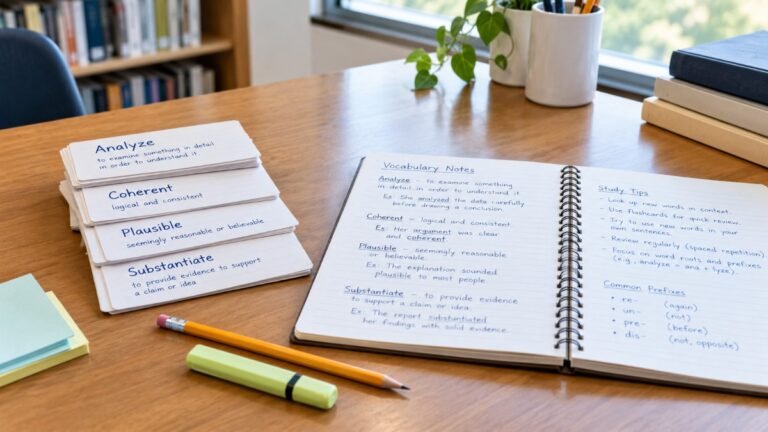
When you encounter an unfamiliar word, avoid writing down only the word and its definition.
Use a three-part method:
1. Word: Mitigate
2. Meaning: Make something less severe.
3. Context: The new drainage system was designed to mitigate flooding.
Then write a new sentence of your own.
This approach helps you connect the definition with the situation in which the word is used. You can repeat the process with words from practice questions, reading assignments, and unfamiliar passages.
Use a Vocabulary Mistake Log
A mistake log helps you identify recurring problems and choose what to practice next.
| Word | Incorrect choice | Correct meaning | Context clue |
|---|---|---|---|
| Novel | Fictional | New or original | A new design |
| Mitigate | Eliminate | Make less severe | Flooding decreased |
| Candid | Formal | Honest and direct | Admitted problems |
| Plausible | Proven | Reasonable or believable | Further testing needed |
| Equivocal | Decisive | Ambiguous | Neither confirmed nor rejected |
Review your log periodically.
If you repeatedly miss questions because you ignore contrast words, focus on sentence relationships. If you know the general meaning but choose an answer that is not precise enough, practice comparing closely related choices.
Your next study session should address the pattern behind your mistakes, not simply introduce more vocabulary.
Words in Context vs. Traditional Vocabulary Tests
A traditional vocabulary test may ask you to define a word in isolation.
A Words in Context question instead places the word within a sentence or short passage and asks you to interpret its meaning or select the word that fits most logically and precisely.
These approaches develop related but different skills.
Traditional vocabulary practice helps you learn meanings. Context-based practice helps you determine which meaning applies in a particular situation and how words relate to the surrounding ideas.
That is why an effective SAT vocab practice test should include complete sentences, plausible answer choices, and explanations of why the correct option fits.
For more question formats and additional practice ideas, see our SAT Practice Questions guide.
How to Practice SAT Vocabulary by Difficulty
If You’re Just Starting
Begin with common academic words and straightforward sentences. Focus on identifying the main idea and recognizing basic clues such as cause, contrast, and examples.
Do not worry about speed until you can explain why your answers are correct.
If You’re Making Progress
Mix vocabulary review with context-based multiple-choice questions. Pay attention to the differences between similar words and review every incorrect answer.
For example, distinguish between mitigate and eliminate, or between plausible and proven.
If You’re Already Performing Well
Focus on precision, nuance, and the author’s intended meaning.
At this stage, the challenge may not be understanding the general idea. It may be choosing the word that expresses it most accurately.
Try to explain why the best answer is more precise than the other options.
A 35-Minute SAT Vocabulary Study Routine
A short, consistent routine can help you build vocabulary knowledge while practicing how to use it.
10 Minutes: Learn
Review a small set of academic words. Learn the definition, part of speech, and an example sentence.
10 Minutes: Practice
Complete a short set of Words in Context questions without a dictionary.
10 Minutes: Review
Check your answers and identify the specific clues you missed.
5 Minutes: Recall
Write your own sentences using the words you found difficult. Try to recall their meanings without looking at your notes.
For a broader preparation plan, see our SAT Prep Study Guide.
Use Official SAT Practice After This Quiz
This practice test is designed to help you work on vocabulary in context. It is not a substitute for official SAT practice.
College Board provides a Student Question Bank containing official SAT Suite questions. Students can filter questions by section, domain, skill, and difficulty. Our SAT College Board resource can also help you find SAT-related College Board information.
After completing this vocabulary quiz, use the official resource to practice Reading and Writing questions in the Craft and Structure domain.
Open the official College Board Student Question Bank
Practicing official questions can help you become familiar with the format and wording used in the actual assessment.
Practice the Full Digital SAT Too
Vocabulary is only one part of SAT Reading and Writing. Full-length practice tests help you work on timing, concentration, reading comprehension, and other tested skills.
College Board offers full-length digital practice tests through Bluebook. After completing a practice test, students can review their results and identify areas that need more attention.
Try official Bluebook SAT practice tests
If you want a dedicated overview of practice-test preparation, see our SAT Practice Test guide.
Learn the Bluebook Environment Before Test Day
If you’re unfamiliar with the digital testing environment, spend some time learning the software before taking a full-length test. You can also review our guide to SAT Policy Changes for related exam-policy information.
Bluebook provides a test preview and full-length practice tests so students can become familiar with navigating questions and using the available tools.
You can find the software through the official Bluebook download page.
Our Bluebook College Board guide also explains how the app works, how to prepare your device, and what to expect before test day.
What If You Keep Getting SAT Vocabulary Questions Wrong?
Do not automatically respond to every incorrect answer by memorizing more words. First, determine what caused the mistake.
You Don’t Know the Word
Learn its meaning and part of speech. Then write an example sentence and revisit the word later.
You Know the Word but Choose the Wrong Meaning
Study the surrounding sentence and check whether the word has another meaning that fits the context better.
Two Answer Choices Seem Correct
Compare their exact meanings, tone, and precision. Ask which option best expresses the author’s intended idea.
You Ignore Sentence Structure
Look for contrast, cause and effect, continuation, and examples. Connecting words often help reveal the relationship between ideas.
You Run Out of Time
Practice with short passages and work toward identifying the main idea before examining the answer choices. Review accuracy first, then gradually work on speed.
Identifying the cause of your errors gives you a more focused way to improve.
Should You Use Flashcards for SAT Vocabulary?
Yes. Flashcards can be useful for learning definitions and reviewing words you repeatedly miss.
However, do not rely only on isolated definitions.
For example:
Front: What does candid mean?
Back: Honest and direct.
Then add a contextual example:
“The scientist gave a candid explanation of the study’s limitations.”
You can also reverse the exercise by reading the sentence and recalling the meaning of the word.
Combining recall with contextual examples helps you practice both vocabulary knowledge and its application.
What SAT Students Should Avoid
Avoid these common preparation mistakes:
- Spending most of your study time memorizing obscure words.
- Assuming the most sophisticated-sounding option is correct.
- Ignoring the sentence surrounding the target word.
- Treating related words as if they have identical meanings.
- Checking answers without understanding why an option is correct.
- Assuming a high score on one short practice set guarantees a particular SAT score.
The purpose of practice is not simply to accumulate correct answers. It is to learn how to interpret sentences and select the most precise meaning.
SAT Vocab Practice Test: Frequently Asked Questions
What is an SAT vocab practice test?
An SAT vocab practice test is a set of vocabulary questions that helps students practice determining word meanings and choosing precise words in context for the Digital SAT Reading and Writing section.
Does the SAT test vocabulary?
Yes. Words in Context is part of the Craft and Structure domain of SAT Reading and Writing. Students may need to interpret a word’s meaning or select a word or phrase that logically and precisely completes a text.
Do I need to memorize difficult words for the SAT?
Not necessarily. Building academic vocabulary is useful, but memorization alone is insufficient. Students should also practice interpreting meaning from context and distinguishing between closely related words.
How many vocabulary words should I learn for the SAT?
There is no official required number of words that guarantees success. Focus on learning useful academic vocabulary and practicing how words function in sentences.
Is a vocabulary list enough for SAT preparation?
No. A vocabulary list can help build word knowledge, but it does not replace context-based practice, reading comprehension, or full-length SAT preparation.
How can I improve my SAT vocabulary quickly?
Practice regularly with short passages, learn unfamiliar words in context, review incorrect answers, and pay attention to transition words and sentence relationships. Consistency and targeted review are more useful than simply memorizing increasingly long lists.
Are these official College Board SAT questions?
No. All 30 questions in this guide are original practice questions created for vocabulary study. They are not official College Board questions.
Where can I find official SAT vocabulary practice?
Use the College Board Student Question Bank and select relevant Reading and Writing skills in the Craft and Structure domain.
What should I do if two vocabulary answers seem correct?
Compare the exact meanings of the two choices. Then insert each one into the sentence and determine which better matches the author’s meaning, tone, and logic.
Can I improve SAT vocabulary without memorizing hundreds of words?
Yes. Learn useful academic words, read regularly, practice context clues, and review your mistakes. You can build vocabulary knowledge while developing the reading skills needed to apply it.
Should I practice SAT vocabulary every day?
Short, regular practice sessions can help you retain vocabulary and identify recurring errors. Combine them with broader Reading and Writing practice rather than spending all your preparation time on vocabulary alone.
Does my score on this quiz predict my SAT score?
No. This is a short, unofficial vocabulary practice set. Its score categories are study guidelines and do not correspond to official SAT scoring.
Final Thoughts
A good SAT vocab practice test should do more than ask you to memorize definitions. It should help you understand how words communicate meaning within sentences.
When you encounter an unfamiliar word, examine the context.
When you recognize a familiar word, check whether its meaning fits the passage.
Look for contrast, cause and effect, and other relationships between ideas. Compare the answer choices carefully and choose the word that most precisely expresses the intended meaning.
Use this 30-question practice test to identify areas for improvement, review the explanations, and record your mistakes. Then continue with official College Board practice to develop your broader Reading and Writing skills.
Learn the words, understand the context, and choose the meaning that best fits the sentence.


1 Comment
[…] broader review of the section, explore our SAT Reading and Writing resources. You can also use our SAT vocabulary practice test to practice applying word meanings in […]