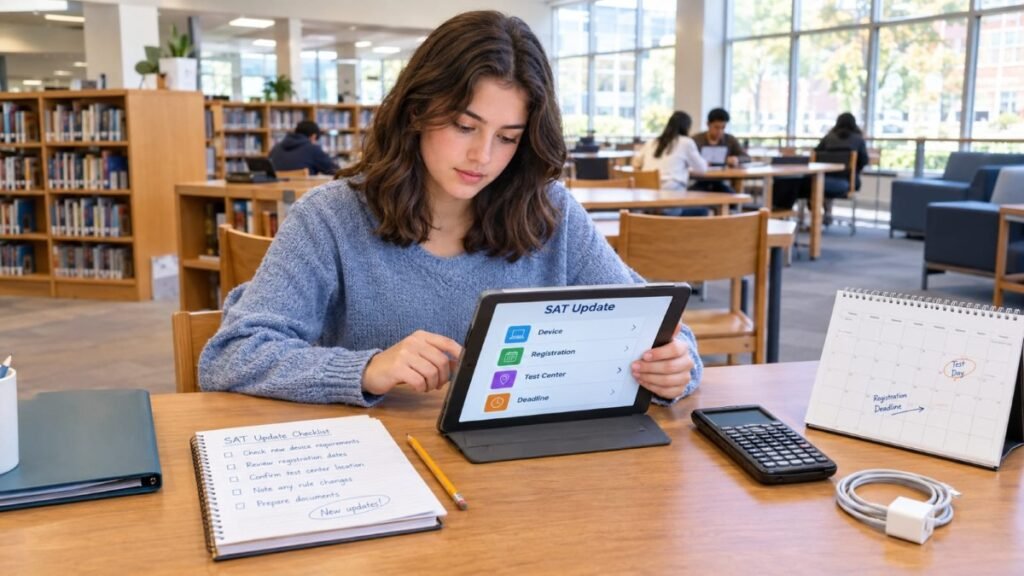
College Board updates can be easy to overlook when you’re busy studying for the SAT.
But some changes can affect the way you register, the device you use, your test-center options, or what you need to do before test day.
For the 2026–27 testing year, College Board has introduced several updates to the SAT experience. These include a new U.S. waitlist, changes to Bluebook, updated device requirements, and new rules for some testing accommodations.
Most students don’t need to completely change how they prepare.
They just need to know which updates actually apply to them.
For a broader look at recent SAT changes, you can also read our Digital SAT Updates guide.
What Are the Latest College Board Updates?
The main student-facing changes for the 2026–27 SAT testing year include:
- A new U.S.-only waitlist when preferred test dates or test centers are full
- A resizable built-in calculator in Bluebook
- Improved viewing for reference sheets, charts, graphs, and images
- Windows 11 requirements for Bluebook
- More specific Chromebook requirements
- Updated rules for certain testing accommodations
College Board lists these changes in its official 2026–27 testing information. (College Board’s official 2026–27 SAT testing changes)
The important question isn’t whether you need to memorize every change.
It’s whether one of these changes affects your SAT.
1. The SAT Waitlist Is Now Available in the U.S.
One of the biggest changes beginning with fall 2026 testing is the new SAT waitlist.
If your preferred SAT date or test center is full, eligible students testing in the United States can join the waitlist.
If a seat becomes available within the selected area, College Board may automatically place the student into that opening. The current waitlist fee is $0.
There is one important thing to understand:
Joining the waitlist does not guarantee a seat.
So if you need a specific SAT date because of a college application deadline, don’t rely on the waitlist alone.
Check other available centers and test dates as well.
The new waitlist is currently described by College Board as U.S. only. International students should not assume the same option is available in their country.
If you’re choosing a testing location, our SAT Test Center Information guide can help.
2. Bluebook’s Built-In Calculator Can Be Resized
Bluebook is still the testing application used for the digital SAT.
For the 2026–27 testing year, students can resize the embedded calculator in the Math section.
That may sound like a minor change, but it can be useful when you want to work with the calculator without covering as much of the question.
The best way to take advantage of this update is to practice with the calculator before test day.
You don’t want the calculator interface to feel unfamiliar during the actual exam.
You can also use an approved handheld calculator if you prefer one.
3. Reference Sheets, Charts, and Images Are Easier to View
College Board has also improved the way certain visual materials appear in Bluebook.
Students can view reference sheets in a different layout and use zoom and pan to take a closer look at charts, graphs, and images.
This can be especially useful when a graph contains several details that are difficult to read at its original size.
It also gives students another reason to include screen-based practice in their preparation.
4. Windows 11 Is Required for Bluebook
This is one of the most important technical changes for students using Windows devices.
College Board says Bluebook requires Windows 11 for the 2026–27 testing year because Microsoft no longer supports Windows 10.
If you’re planning to use a Windows laptop or tablet, check the operating system before the SAT.
Don’t assume a computer that works for school assignments will automatically meet the testing requirements.
If you’re unsure about your device, our SAT Requirements guide covers the broader requirements you should review.
5. Chromebook Requirements Are More Specific
Students can still use supported school-managed Chromebooks, but College Board says Bluebook will work on Chromebooks only when verified mode is enabled.
This is particularly important if your school manages the device.
You may not have permission to change the settings yourself.
Ask the school’s technology staff to confirm that the Chromebook is configured correctly before test day.
College Board’s official SAT Device Readiness guide provides the current device information.
6. Personal Chromebooks and Phones Are Not Supported
There is an important difference between an approved school-managed device and a personal device.
College Board currently says students can use supported Windows laptops or tablets, Mac laptops, iPads, and school-managed Chromebooks.
A personal Chromebook cannot be used, and a mobile phone is not an approved SAT testing device.
That means students should check the exact device they’ll use well before the exam.
If your first-choice device doesn’t qualify, you’ll still have time to find another option.
7. Bluebook Setup Must Be Done Before the SAT
Downloading Bluebook is only part of getting ready.
College Board currently recommends downloading the app well ahead of test day so students can practice and make sure their device works properly.
Then, 1–5 days before the SAT, students complete exam setup. The setup downloads the test and generates the admission ticket.
College Board also advises students to open Bluebook on test morning to check for last-minute messages and updated test-center information.
So don’t leave Bluebook setup until you’re already at the testing center.
8. College Board May Be Able to Lend a Testing Device
Not every student has access to an approved laptop or tablet.
College Board may be able to lend a testing device to eligible students who don’t have another suitable option.
There is an important timing requirement: students who need a loaned device must request one at least 30 days before test day.
A loaned device isn’t something you should treat as an automatic guarantee.
If you know you’ll need one, start the process early.
Waiting until the final weeks before the SAT can create an unnecessary problem.
9. Some Testing Accommodations Have New Requirements
Students using approved testing accommodations should pay close attention to the 2026–27 changes.
College Board says students approved for Text-to-Speech (Embedded) accommodations will take SAT Weekend at a test center unless they are approved for another school-based accommodation.
Students approved for text-to-speech or screen-reader accommodations must also bring their own wired, non-Bluetooth headphones.
If you use accommodations, follow the instructions associated with your current approval.
Don’t assume that the setup you used for a previous SAT will be identical.
What Hasn’t Changed About the Digital SAT?
The 2026–27 updates may sound significant, but they don’t turn the SAT into a completely different exam.
The SAT remains digital and includes:
- Reading and Writing
- Math
- A 400–1600 total score scale
The major updates are mainly about the technology, access, and testing experience.
So if you’ve already been preparing, you don’t need to throw away your entire study plan.
Adjust where necessary and keep working on the core SAT skills.
How Should Students Prepare for These Updates?

The smartest approach is to combine academic preparation with digital familiarity.
Practice on Your Testing Device
Whenever possible, practice on the device you’ll actually use for the SAT.
Get comfortable with:
- Bluebook navigation
- The embedded calculator
- Reference sheets
- Charts and graphs
- Zoom and pan
- Moving between questions
That way, the technology becomes part of your normal routine rather than something new on test day.
Keep Your Academic Preparation on Track
The updates don’t replace the need to study.
You still need to work on Math and Reading and Writing, practice under time limits, and review your mistakes.
If you need a structured routine, our SAT Study Plans guide can help you organize your preparation.
Do the New Updates Change SAT Math?
The calculator update is the most noticeable Math-related change.
Students can resize the built-in calculator, but the underlying Math skills remain the same.
You still need to know how to set up equations, interpret data, and solve problems efficiently.
Use the calculator when it helps, not simply because it’s available.
Do the Updates Change SAT Reading and Writing?
There isn’t a completely new Reading and Writing section for 2026–27.
The main relevant change is how certain visual information is displayed and viewed in Bluebook.
Students should still focus on reading efficiently, understanding evidence, analyzing ideas, and managing time.
Digital practice can help you become more comfortable with the screen.
Do College Board Updates Change SAT Scoring?
No.
The 2026–27 testing changes do not introduce a new scoring scale.
The SAT continues to use the familiar 400–1600 total score, with separate Math and Reading and Writing section scores.
So students who are already preparing don’t need to learn a different scoring system.
Do College Board Updates Change SAT Registration?
The basic registration process remains familiar.
Students choose an SAT date and testing location through their College Board account.
However, the new waitlist and current device requirements make it more important to check test-center availability and technology before choosing a date.
Our SAT Registration 2026 guide covers the registration process.
For current official registration dates and deadlines, College Board’s SAT Dates and Deadlines page is the place to check.
What Are the Current SAT Fees?
The SAT registration fee for U.S. students is currently $68.
College Board also lists a $38 late-registration fee for students who register after the regular deadline but before the late-registration deadline. The current waitlist fee is $0.
Fees can change, so check the official College Board SAT Test Fees page before registering.
If you need to register after the normal deadline, our SAT Late Registration guide explains the process.
Do College Board Updates Affect Test Centers?
They can.
The new waitlist gives eligible U.S. students another option when preferred test dates or centers are full.
At the same time, students should still keep an eye on their current test-center information.
A test center can change for operational reasons, so don’t rely only on an old address saved during registration.
Do Digital SAT Updates Change ID Requirements?
The technology changes don’t replace the current identification rules.
If your testing situation requires an ID, you should still make sure you have an acceptable physical photo ID that meets College Board’s requirements.
A photo or digital copy on your phone shouldn’t be treated as a substitute for required physical identification.
For the details, see our SAT ID Requirements guide.
How Do College Board Updates Affect College Applications?
Most of the current changes are technical, but they can still affect students who are planning around college deadlines.
For example, students who need a loaned device have to request it early.
Students who depend on a particular test center may need to consider another location or the U.S. waitlist.
And students taking the SAT for college admissions need to make sure their selected test date fits the testing rules for the schools on their list.
Our SAT for College Admissions guide covers the larger role of SAT scores in the application process.
Remember that College Board manages the SAT, while individual colleges decide their own admissions and testing policies.
A College Board update doesn’t automatically change a college’s SAT requirement.
When Will SAT Scores Be Released?
College Board publishes a score-release schedule for each SAT administration.
For example, students taking the November 7, 2026 SAT are scheduled to receive their scores on November 20, 2026.
Weekend SAT scores are generally released two to four weeks after testing, although students should always check the official schedule for their specific test date.
You can also track upcoming dates through our SAT Score Release Dates 2026 guide.
What Should Students Do If They’ve Already Registered?
You don’t need to change your registration simply because College Board announced a new update.
Instead, check whether the update affects your situation.
Using Windows? Confirm Windows 11.
Using a Chromebook? Make sure it’s a supported school-managed device with the required settings.
Need a loaned device? Check the 30-day request requirement.
Using accommodations? Review your current approval instructions.
Preferred center full? Check other locations and the U.S. waitlist.
Already registered? Complete Bluebook exam setup before the SAT.
For most students, that’s all that’s necessary.
What Should Students Do If They Haven’t Registered Yet?
Start with your college timeline.
Then check:
- Available SAT dates
- Test-center availability
- College application deadlines
- Device requirements
- Accommodation requirements, if applicable
Once you’ve chosen a date, register early enough to avoid relying on late registration or a full-center waitlist.
You can review the current official deadlines on College Board’s SAT Dates and Deadlines page.
How Often Should You Check for College Board Updates?
You don’t need to check the College Board website every day.
A simple routine is enough.
When You Register
Check current dates, deadlines, fees, and device requirements.
During Your Preparation
Make sure your device and Bluebook continue to work properly.
A Few Days Before the SAT
Complete exam setup and check your admission ticket.
Before Leaving for the Test
Check your latest test-center information for any changes.
This keeps you informed without distracting you from the actual SAT preparation.
College Board Updates Checklist
Registration
- Correct SAT date
- Correct test center
- Current registration deadline
- Late-registration deadline if needed
Device
- Approved testing device
- Windows 11 if using Windows
- Supported school-managed Chromebook if applicable
- Required Chromebook settings
- Bluebook installed
Bluebook
- Exam setup completed
- Admission ticket available
- Calculator familiar
- Digital tools practiced
Testing
- Acceptable physical ID if required
- Calculator if using an approved handheld model
- Pencil or pen
- Transportation plan
College Planning
- Test date fits your application timeline
- College testing policy checked
- Score-release timing understood
Frequently Asked Questions
What are the latest College Board updates for the SAT in 2026?
Major 2026–27 changes include a new U.S.-only waitlist, a resizable embedded calculator, improved viewing tools in Bluebook, Windows 11 requirements, Chromebook verified mode requirements, and changes for certain testing accommodations.
What is the new SAT waitlist?
Eligible students testing in the United States can join a waitlist when their preferred test date or center is full. If a seat becomes available, College Board may automatically place the student into it. A seat is not guaranteed.
Does the SAT waitlist cost money?
College Board currently lists the U.S. waitlist fee as $0.
Is the SAT waitlist available outside the United States?
The new waitlist option is currently described by College Board as U.S. only.
Is Windows 11 required for the Digital SAT?
Yes. College Board says Bluebook requires Windows 11 for the 2026–27 testing year.
Can I use a Chromebook for the SAT?
Supported school-managed Chromebooks can be used when the required verified mode is enabled. Personal Chromebooks are not supported.
Can I take the SAT on my phone?
No. A mobile phone is not an approved SAT testing device.
Has the Bluebook calculator changed?
Yes. Students can resize the embedded calculator in the Math section.
Are reference sheets easier to use in Bluebook?
Yes. College Board has improved how reference sheets and visual materials are displayed and can be viewed.
Do I need to complete Bluebook setup before the SAT?
Yes. College Board says students complete exam setup 1–5 days before the test, and the process generates the admission ticket.
Can College Board lend me a device?
College Board may be able to lend an approved testing device to eligible students who don’t have another suitable device. Requests must be made at least 30 days before test day.
Do students using accommodations have new requirements?
Some do. College Board says students using certain text-to-speech or screen-reader accommodations must bring wired, non-Bluetooth headphones.
Do College Board updates change the SAT score scale?
No. The SAT remains on the 400–1600 scale.
Do these updates change the SAT questions?
The current 2026–27 changes mainly concern the digital testing experience, devices, access, and accommodations rather than replacing the SAT with a different examination.
Do College Board updates change college admissions requirements?
Not automatically. Colleges establish their own admissions and testing policies.
What is the current SAT registration fee?
The U.S. SAT registration fee is currently $68, with a $38 late-registration fee listed through December 2026.
When do SAT scores come out?
College Board publishes a specific release date for each SAT administration. For example, the November 7, 2026 SAT has a scheduled student score-release date of November 20, 2026.
Where should I check official College Board updates?
Start with the official College Board 2026–27 SAT testing changes page and the SAT Device Readiness page. These provide the current information about testing changes and supported devices.
Final Thoughts
The latest College Board updates for the 2026–27 SAT testing year are mostly practical changes.
The most important ones for students are the new U.S. waitlist, updated Bluebook tools, Windows 11 and Chromebook requirements, device preparation rules, and changes affecting certain accommodations.
You don’t need to constantly monitor every College Board announcement.
Instead, check the requirements that apply to you.
Make sure your device is supported.
Get Bluebook ready before the exam.
Know your registration and test-center options.
And if you’re using the SAT for college applications, make sure your test date fits your school’s testing policy and deadlines.
Stay current on the changes that affect you, then keep your focus on preparing for the SAT itself.



2 Comments
[…] changes are part of College Board’s 2026–27 SAT testing updates. You can also read our College Board Updates guide for broader […]
[…] can also read our College Board Updates guide for broader coverage of recent SAT […]