If you’re planning to apply to college in the United States, you’ve probably come across the same question many students ask: Should I take the ACT or SAT?
There isn’t a universal answer. Both exams are used for college admissions, and many U.S. colleges accept either one. The better choice usually comes down to how you perform on each test, how comfortable you are with the format, and which type of questions and pacing suit you better.
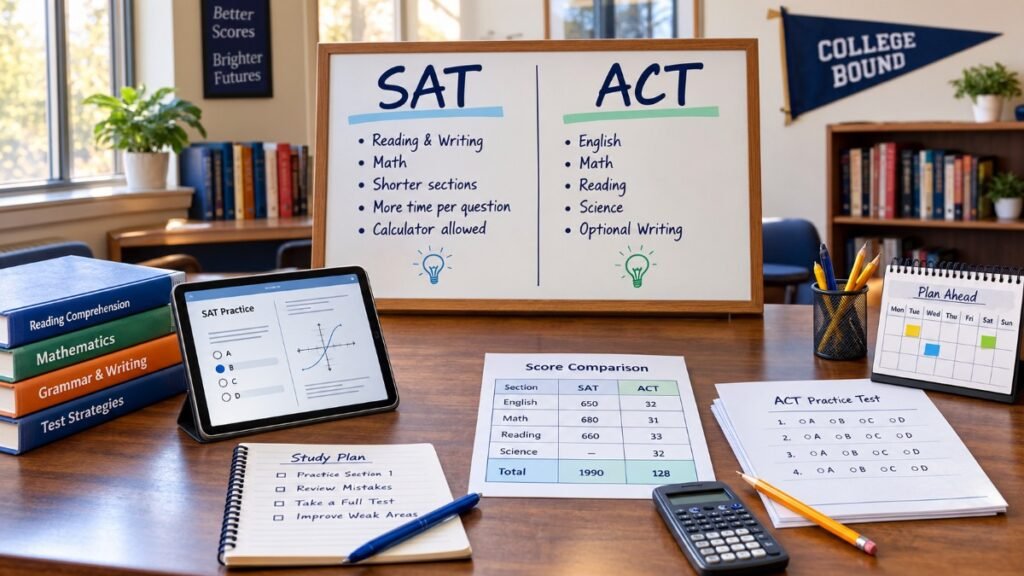
The SAT and ACT are also not identical. The SAT is a digital, adaptive test, while the ACT follows a linear format. Their sections, timing, scoring, and approach to Science are different as well.
So instead of choosing based on what a friend is taking or which test someone online says is easier, it makes more sense to understand the differences and compare your own performance.

ACT vs SAT: Quick Comparison
| Feature | SAT | ACT |
|---|---|---|
| Format | Digital | Digital or paper, depending on administration |
| Test structure | Adaptive | Linear |
| Main sections | Reading and Writing, Math | English, Math, Reading |
| Science | No separate Science section | Optional |
| Writing | No essay | Optional Writing |
| Score range | 400–1600 | 1–36 Composite |
| Calculator | Allowed throughout Math | Allowed throughout Math |
| Pacing | More time per question | Faster pace |
The current SAT has two sections: Reading and Writing and Math. Each section is divided into two modules, and the second module is based partly on performance in the first. College Board lists 64 minutes for Reading and Writing and 70 minutes for Math.
The current ACT has English, Math, and Reading as its core sections. Science and Writing are optional. ACT has also changed its format in recent years, so students should use current ACT information rather than older prep material.
Are the ACT and SAT Both Accepted by Colleges?
For most students, college acceptance isn’t a good reason by itself to choose one test over the other.
College Board says that most U.S. colleges accept both the SAT and ACT and generally don’t prefer one test over the other. Still, individual colleges can have their own testing policies, so it’s important to check the current requirements for the schools you’re considering.
If you already have an SAT score and want to understand how it compares with an ACT score, official concordance information can be useful. Keep in mind that a concordance is a comparison tool, not a guarantee that you would earn the corresponding score if you took the other exam.
For current SAT registration, testing information, official resources, and other College Board-related information, see our SAT College Board guide.
For the most current SAT information, you can check the official College Board SAT website.
What Is the Biggest Difference Between the ACT and SAT?
There are a few differences that stand out immediately.
The SAT is digital and adaptive. The ACT is linear.
The SAT combines Reading and Writing into one section. The ACT has separate English and Reading sections.
The ACT also has an optional Science section, while the SAT doesn’t have a separate Science section.
Then there’s pacing.
The SAT generally gives students more time per question. The ACT requires students to work more quickly, although the current ACT has more time per question than older versions of the test.
These differences can make one exam feel more comfortable than the other.
What Is the SAT Format?
The SAT currently has two sections:
- Reading and Writing
- Math
Reading and Writing contains 54 questions and gives students 64 minutes.
Math contains 44 questions and gives students 70 minutes.
There is also a 10-minute break between the two sections.
The SAT is administered digitally, and calculator use is permitted throughout the Math section. The digital testing platform also includes an embedded Desmos calculator.
If you’re considering the SAT, it’s worth understanding the current format before you start studying.
Our SAT Prep Study Guide covers everything from diagnostic testing and study schedules to Math, Reading and Writing, practice tests, timing, mistake tracking, and test-day preparation.
You can also read our Digital SAT Updates guide if you want to keep up with changes to the digital exam.
What Is the ACT Format?
The current ACT has three core sections:
- English
- Math
- Reading
Science is optional, and Writing is optional.
The ACT’s structure is linear, meaning the difficulty doesn’t adapt based on your performance earlier in the test.
That can be appealing if you prefer knowing what you’re going to face rather than having the second part of a section affected by your earlier performance.
The ACT also moves quickly. Students who are comfortable reading and solving problems under tight time limits may find that format manageable.
For current ACT information, check the official ACT website.
Is the SAT Easier Than the ACT?
Not necessarily.
This is one of the most common questions students ask, but there’s no test that’s automatically easier for everyone.
A student who is comfortable with the SAT’s digital format and has more time per question may prefer the SAT.
Another student who reads quickly and works well under time pressure may feel more comfortable with the ACT.
That’s why your own practice performance matters more than a general claim that one test is easier.
If you have enough time, try a realistic practice test for both.
SAT vs ACT: Timing and Pacing
Timing is one of the areas where students often notice the biggest difference.
The SAT gives 64 minutes for 54 Reading and Writing questions and 70 minutes for 44 Math questions.
The ACT’s core sections require a faster pace.
That doesn’t mean the ACT is automatically harder. It simply means that students have to make decisions more quickly.
Think about what happens when you face a difficult question.
Do you normally work through it quickly and move on?
Or do you prefer taking extra time to check the details and make sure you’ve understood everything?
Your answer can tell you something about which test format may fit you better.
If you’re preparing for the SAT specifically, our SAT Tips guide can help you work on timing, question selection, and other preparation strategies.
SAT vs ACT for Students Who Read Slowly
Reading speed can make a difference.
The SAT’s Reading and Writing section uses shorter passages and focuses on areas such as information and ideas, craft and structure, expression of ideas, and standard English conventions.
The ACT has a separate Reading section and requires students to work through it at a relatively fast pace.
If you tend to reread passages several times, pay attention to how that affects your practice-test results.
Don’t automatically assume that slower reading means you should take the SAT, though.
Take a realistic practice test and see how your accuracy and timing actually look.
SAT vs ACT for Strong Math Students
Both exams test Math, but the experience isn’t exactly the same.
SAT Math contains 44 questions over 70 minutes, while ACT Math contains 45 questions over 50 minutes.
Both allow calculator use during Math.
For some students, the difference isn’t really about the Math itself. It’s about how quickly they can solve the problems.
A student who understands the material but works slowly may have a different experience from someone who can solve familiar problems very quickly.
When comparing the tests, look at both your accuracy and your time.
A high number of correct answers isn’t as useful if you couldn’t finish the section under realistic conditions.
Does the ACT Have a Science Section?
Yes.
Science is an optional ACT section under the current format.
The section focuses on interpreting and analyzing scientific information, including data, experiments, graphs, and scientific reasoning.
If you enjoy working with data and scientific information, you may find this section comfortable.
But don’t assume that you need to take ACT Science simply because you’re interested in a STEM major.
Check the requirements of the colleges you’re considering before making that decision.
Does the SAT Have a Science Section?
No.
There is no separate Science section on the SAT.
That doesn’t mean science-related information never appears. Students can still encounter data, charts, and scientific contexts within SAT questions.
The difference is that the SAT doesn’t give you a separate Science score or Science test section.
SAT vs ACT: Which Test Has More Questions?
The current SAT has 98 questions in total:
- 54 Reading and Writing
- 44 Math
The ACT has more questions across its core sections.
But simply counting questions isn’t a useful way to decide which test is better for you.
What matters is the combination of:
Number of questions + time available + question difficulty + your accuracy.
A test with fewer questions isn’t automatically easier.
A test with more questions isn’t automatically harder.
SAT vs ACT: Which Is Better for Fast Test Takers?
If you naturally work quickly and remain accurate, the ACT may be worth considering.
Its core sections require you to move efficiently from one question to the next.
But speed by itself isn’t enough.
If working quickly causes you to make careless mistakes, the advantage disappears.
The goal is to find the balance between speed and accuracy.
If you’re fast and accurate, that’s useful.
If you’re slower but consistently accurate, you should pay close attention to how the SAT’s pacing feels during a practice test.
Which Test Is Better If You Need More Time?
Students who like having more time to analyze questions may find the SAT’s pacing more comfortable.
College Board describes the SAT as providing more time per question than the ACT.
But more time doesn’t mean you should spend several minutes on a single difficult problem.
You still need a strategy for moving forward when you’re stuck.
That skill is especially important on test day because one difficult question shouldn’t consume the time you need for several easier questions.
SAT vs ACT: Digital Testing
The SAT is digital.
The ACT can be offered digitally or on paper, depending on the testing situation and location.
This can matter if you have a strong preference for one testing environment.
Digital testing requires a different set of habits.
You need to be comfortable reading on a screen, navigating between questions, using digital tools, and keeping track of time without relying on a traditional paper test booklet.
If you’re leaning toward the SAT, practicing in the same type of digital environment can make the real test feel more familiar.
SAT vs ACT: Which One Uses a Calculator?
Both tests allow calculator use in Math.
The SAT allows calculators throughout the Math section and provides an embedded Desmos calculator in its digital testing environment.
The ACT also permits calculators throughout Math, subject to its calculator policy.
The important question isn’t simply whether a calculator is allowed.
It’s whether you know how to use one efficiently.
For SAT students, spending some time practicing with the digital calculator can be worthwhile. You don’t want to spend test day figuring out basic calculator functions.
SAT vs ACT Scoring
The SAT uses a total score range of 400 to 1600.
The ACT uses a 1–36 Composite score.
Because the scoring systems are different, students sometimes use concordance tables to compare scores.
That’s fine for general comparison, but don’t treat a converted score as a prediction of exactly what you would earn on the other test.
Your actual performance can depend on the test format, timing, question types, and your preparation.
Should You Take Both the SAT and ACT?
You can, but you don’t necessarily need to.
A useful approach is to take a realistic practice test for each exam before committing to a preparation plan.
For example, you could take an SAT practice test one weekend and an ACT practice test the following weekend.
Then compare more than just the final scores.
Look at your accuracy, timing, mistakes, and overall experience.
If one test clearly fits you better, you can focus your preparation there.
Preparing seriously for two different exams at the same time can split your attention, so having a clear reason for taking both is helpful.
How to Compare Your SAT and ACT Practice Tests
Create a simple comparison.
For the SAT, record:
- Overall score
- Math performance
- Reading and Writing performance
- Timing problems
- Careless mistakes
- Topics you struggled with
- Questions you guessed on
For the ACT, record:
- Composite score
- English performance
- Math performance
- Reading performance
- Science performance, if taken
- Timing problems
- Careless mistakes
- Topics you struggled with
Then ask yourself a few simple questions.
Which test allowed you to work more comfortably?
Where did you make fewer careless mistakes?
Which test caused fewer timing problems?
Which sections felt easier to understand?
Which mistakes seemed easier to fix?
That information is much more useful than simply asking which exam has a reputation for being easier.
What If My SAT Practice Score Is Higher?
If your SAT practice result is noticeably stronger, take a closer look at why.
Maybe you liked the pacing.
Maybe you were more comfortable with the Reading and Writing questions.
Maybe the digital format worked well for you.
Maybe you made fewer Math mistakes.
Understanding the reason behind the difference can help you decide whether the SAT is the better exam to focus on.
What If My ACT Practice Score Is Higher?
Use the same process.
Look at your section-level performance.
Maybe English was a particularly strong area.
Maybe you handled the fast pace well.
Maybe the Reading format suited you.
Maybe you performed well on the optional Science section.
A higher practice score can be useful information, but the details behind that score matter too.
What If My SAT and ACT Scores Are Similar?
That’s not unusual.
If the results are close, look beyond the scores.
Consider which test format you prefer, which one feels less tiring, and which one gives you fewer timing problems.
You can also consider your available preparation time.
If the results remain close after another realistic practice test, your choice may come down to which test you prefer preparing for and which one fits your college application timeline.
Which Test Should You Take If You’re Strong in Science?
Being good at science doesn’t automatically mean you should take the ACT.
The ACT has an optional Science section, but whether you should take it depends partly on the colleges you’re considering and how they use ACT scores.
If you enjoy interpreting graphs, experiments, and scientific data, taking an ACT practice Science section can help you see whether it suits you.
Don’t make the decision based only on your intended major.
Check the current requirements of your target colleges.
Which Test Should You Take If You’re Strong in Reading and Writing?
Look closely at the formats.
The SAT combines Reading and Writing.
The ACT separates English and Reading.
If you like grammar, editing, and sentence-level questions, you may enjoy ACT English.
If you prefer the SAT’s shorter passages and combined Reading and Writing format, the SAT may feel more natural.
Again, a practice test can tell you more than a general description.
Which Test Should You Take If You’re Strong in Math?
Strong Math skills are useful on both tests.
Instead of asking which test has “better” Math, look at how you perform under the actual time limits.
Consider your:
- Algebra skills
- Problem-solving ability
- Calculation speed
- Accuracy
- Word-problem skills
- Comfort with calculators
Your Math performance should be considered alongside your performance in the other sections.
How Should You Prepare Before Choosing?
You don’t need to spend months preparing for both tests just to make a decision.
Start with one realistic practice test for each.
Then compare the results.
If you’re leaning toward the SAT, our SAT Prep Study Guide gives you a structured way to move from your diagnostic score into targeted preparation.
You can also use an official SAT practice test to become familiar with the digital format.
Once you’ve chosen the SAT, your next step is to build a schedule around your test date. Our SAT Test Dates page can help you plan your preparation timeline.
Don’t Choose Based on Old SAT or ACT Advice
One thing students often overlook is how much these exams have changed.
Older articles and videos may describe versions of the SAT or ACT that are no longer current.
The SAT is now digital and adaptive.
The ACT has also changed its structure, including its timing and the role of Science.
That’s why current official information matters.
Before registering, check the latest information from the test provider and the colleges you’re considering.
A Simple Way to Decide Between the ACT and SAT
If you’re still unsure, keep it simple.
Take an official or realistic SAT practice test.
Then take an official or realistic ACT practice test.
Don’t worry about getting a perfect score on either one.
Instead, pay attention to how you actually perform.
Look at your accuracy.
Look at your timing.
Look at your mistakes.
Think about how comfortable you felt with the questions.
Then choose the exam that gives you the clearest path toward improving your performance.
Once you’ve chosen the SAT, you can use resources such as our SAT Practice Test to continue practicing and identifying weak areas.
ACT vs SAT: Common Questions
Is the SAT harder than the ACT?
Not for everyone. The difficulty depends on the student, the test format, and the skills being tested. Some students perform better on the SAT, while others perform better on the ACT.
Do colleges prefer the SAT or ACT?
Many U.S. colleges accept both tests and generally don’t prefer one over the other. However, individual colleges can have their own testing policies, so always check the current requirements of the schools you’re interested in.
Is the ACT faster than the SAT?
The ACT generally requires students to work at a faster pace. The current ACT has more time per question than older versions, but its pacing is still different from the SAT.
Does the ACT still have a Science section?
Yes. Science is an optional section under the current ACT format.
Does the SAT have a Science section?
No. The SAT doesn’t have a separate Science section.
Is the SAT completely digital?
Yes. The SAT is administered digitally, with specific arrangements for certain accommodations.
Can the ACT be taken on paper?
Yes. ACT offers paper and digital options depending on the testing situation and location.
Should I take both tests?
You don’t have to. Taking realistic practice tests for both can be useful if you’re unsure which format fits you better. Once you have enough information, focusing your preparation on one exam can make your study time more efficient.
How do I know which test is right for me?
Take a realistic practice test for each exam and compare your accuracy, timing, mistakes, and comfort with the format. Your own performance is more useful than general claims about which test is easier.
Final Thoughts
Choosing between the ACT and SAT doesn’t need to be a stressful decision.
Start with the actual tests instead of assumptions.
Take a realistic SAT practice test. Take a realistic ACT practice test. Then look closely at what happened.
Maybe you performed better on one.
Maybe the scores were similar but one test felt more comfortable.
Maybe your Math was strong on both but timing was a problem on the ACT.
Or perhaps the SAT’s digital format simply made more sense to you.
Those details matter.
The SAT is a digital, adaptive exam with Reading and Writing and Math. The ACT is a linear exam with English, Math, and Reading as its core sections, along with optional Science and Writing.
Once you understand those differences, you can make a decision based on your own strengths rather than someone else’s opinion.
If you choose the SAT, don’t jump straight into random practice questions. Start with a diagnostic test, identify your weak areas, build a realistic schedule, and review your mistakes carefully.
Our SAT Prep Study Guide can help you build that preparation process step by step.
The goal isn’t simply to spend more hours studying.
It’s to spend those hours on the areas that actually need improvement.
The best test for you is the one whose format allows you to demonstrate your skills most effectively and gives you a preparation path you can realistically follow.



1 Comment
[…] you’re not sure whether the SAT is the right test for you, read our ACT vs SAT comparison before building your study […]