
Taking the SAT is only one part of the college application process. Once your score is available, you may still have an important question to figure out: How do you send SAT scores to colleges?
If you’re a U.S. high school student, this can seem more complicated than it really is. You might be wondering whether colleges need official score reports, whether you can choose which SAT scores to send, how much score reports cost, or whether you can send your scores for free.
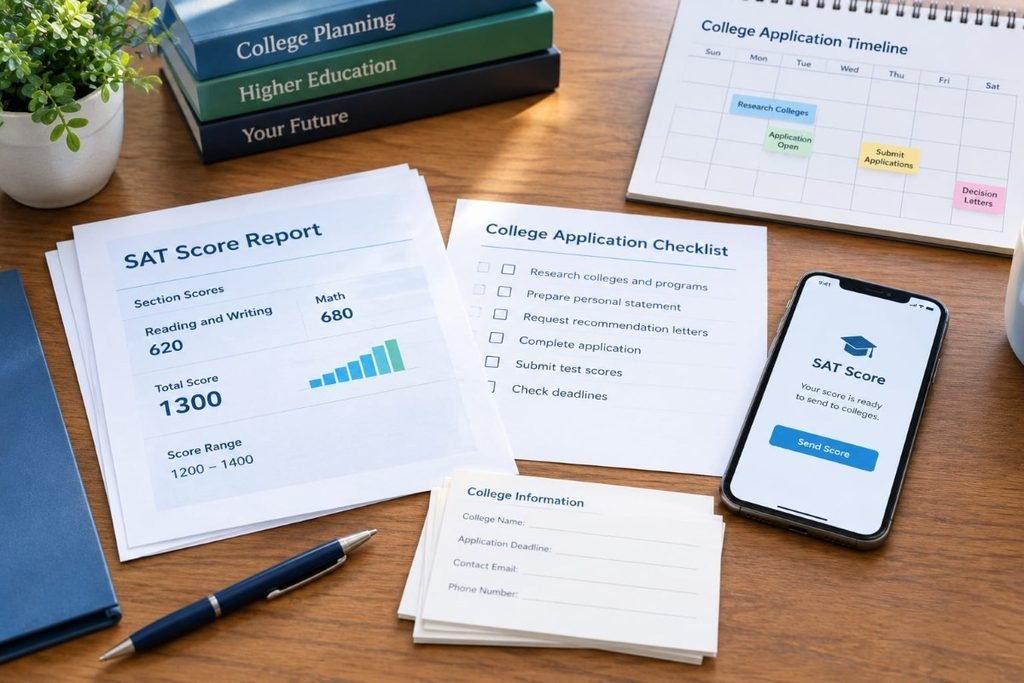
The answer depends partly on the college you’re applying to.
Some colleges accept self-reported SAT scores. Others ask for official scores directly from College Board. Some schools allow students to use Score Choice, while others may have different score-reporting requirements.
That’s why it’s worth understanding the process before you click the button to send your scores.
In this guide, we’ll walk through how to send SAT scores, when you can send them for free, what Score Choice means, how SAT superscoring works, and what you should check before sending scores to a college.
What Does It Mean to Send SAT Scores?
When you send SAT scores, you’re asking College Board to provide your SAT results to a college, university, scholarship program, or another eligible organization.
This is different from simply entering your SAT score into an application.
For example, you might enter a 1320 on your college application as a self-reported score. If the college requires an official score report, however, you’ll need to have College Board send the score directly.
Not every college handles SAT scores in exactly the same way.
Some schools allow self-reported scores during the application process and request official scores later. Others may require official score reports from the beginning.
Before sending your scores, check the testing policy for every college on your list.
How to Send SAT Scores to Colleges
The process for sending SAT scores is generally straightforward.
You’ll use your College Board account to select the colleges or organizations that should receive your scores.
The basic process looks like this:
- Sign in to your College Board account.
- Open your SAT score information.
- Select the option to send SAT scores.
- Search for the college or organization.
- Select the correct recipient.
- Review the score information and any applicable fees.
- Submit your score-sending request.
If you’re having trouble accessing your account, our College Board Login guide can help you get back into your account.
Before submitting your request, carefully check the name of the college you’re selecting. Some institutions have similar names, so it’s worth taking an extra moment to make sure you’ve chosen the correct one.
For the official College Board instructions, you can also visit College Board’s SAT score-sending page.
Can You Send SAT Scores for Free?
Yes, depending on your circumstances.
For a weekend SAT, College Board currently allows students to send their scores to up to four colleges, universities, or scholarship programs for free when the recipients are selected during the applicable free-score period.
Students can select their recipients when registering, before taking the test, or within the allowed period after taking the SAT.
That can be useful if you already know which schools you’re considering.
For example, imagine you’re a junior and already have four colleges that you’re seriously considering. You could potentially use your four free score sends for those schools.
But there’s no reason to rush just because the free score sends are available.
If you’re still building your college list, take a little time to check each school’s SAT policy first.
You want to know whether the college accepts SAT scores, whether official reports are required, and whether it has any specific score-reporting rules.
How Much Does It Cost to Send SAT Scores?
If you’re using an eligible free score send, you won’t pay an additional score-report fee.
Additional score reports can cost money.
College Board currently lists an additional SAT score report at $15 per report. Rush reporting has an additional charge.
Here’s a simple overview:
| Score-sending option | Cost |
|---|---|
| Eligible free score send | $0 |
| Additional SAT score report | $15 |
| Rush reporting | Additional fee |
| Eligible fee-waiver student | Free score reports |
Fees can change, so it’s smart to check the current College Board fee information before ordering a score report.
If you’re trying to understand the cost of taking the test itself, our SAT registration fees guide explains the expenses associated with SAT registration.
Can You Send SAT Scores for Free With an SAT Fee Waiver?
Yes.
Students who qualify for an SAT fee waiver receive additional benefits related to SAT score reporting.
College Board states that eligible students can send unlimited SAT score reports to colleges for free.
This can make a noticeable difference for students applying to several schools.
For example, suppose you’re applying to 10 colleges and each one requires an official SAT score report. Without a fee waiver, additional score-report fees could add up.
With an eligible SAT fee waiver, you can send your scores without paying those score-report charges.
If you’re not sure whether you qualify or want to understand the other benefits, you can read our SAT Fee Waiver guide.
Always check the current College Board requirements because eligibility rules and benefits can change.
When Should You Send SAT Scores?
There’s no single date that works for every student.
Your timing should depend on your college list, SAT scores, upcoming test dates, and application deadlines.
Before sending your scores, check whether each college:
- Requires official SAT scores
- Accepts self-reported scores
- Requires all SAT scores
- Allows Score Choice
- Uses SAT superscoring
- Has a specific score deadline
For example, suppose you took the SAT in October and received your score in November. You’re also registered for another SAT in December.
If your college deadline is still several weeks away, you may decide to wait for your December score before making a final decision.
But if your application deadline is approaching, waiting too long could create a problem.
It’s also useful to keep track of when your scores are expected to arrive. Our SAT Score Release Dates 2026 guide can help you plan around score-release dates.
How Do You Know When Your SAT Score Is Available?
After taking the SAT, students often check their College Board account to see when their scores become available.
Score-release timing can vary by test administration, and scores aren’t necessarily posted at the exact same time for every student.
If you’re waiting for a particular score release, our SAT Score Release Time guide explains what students can expect on score-release day.
Knowing your score-release timing can be especially helpful if you’re deciding whether to send an existing score or wait for a new SAT result.
Do Colleges Require Official SAT Scores?
This is one of the most important things to check before sending your scores.
Some colleges allow students to self-report SAT scores during the application process.
Other colleges require official score reports directly from College Board.
A college may also allow self-reporting during the initial application but require an official score later if you’re admitted or enrolling.
Because policies vary, don’t rely on what a friend, parent, or another college told you.
Check the current policy for the specific school you’re applying to.
If official scores are required, use College Board’s score-sending system rather than assuming that a screenshot or downloaded score report will be enough.
Do You Have to Send All Your SAT Scores?
Not always.
If you’ve taken the SAT multiple times, College Board’s Score Choice feature may allow you to choose which test dates to send.
For example, imagine you took the SAT three times:
| Test Date | SAT Score |
|---|---|
| First test | 1190 |
| Second test | 1270 |
| Third test | 1350 |
If a college allows Score Choice, you may be able to select the test date or dates you want to send.
However, some colleges and scholarship programs have their own requirements and may require all SAT scores.
So don’t assume that you can automatically leave an earlier score out.
The college’s own policy is what matters.
What Is SAT Score Choice?
Score Choice is a College Board feature that allows students to choose which SAT test dates they want to send to colleges.
This can be helpful if you’ve taken the SAT more than once.
For example:
- First SAT: 1210
- Second SAT: 1300
If a college permits Score Choice, you may be able to send the second test date rather than automatically sending both.
However, Score Choice doesn’t override a college’s own admissions requirements.
If a school requires applicants to submit all SAT scores, you should follow that requirement.
It’s also important to understand that Score Choice and free score sends aren’t necessarily handled in exactly the same way. Read the current College Board instructions carefully before using a free score report.
Can You Send Only Your Highest SAT Section?
No.
This is a common misunderstanding among students who take the SAT more than once.
You can’t tell College Board to send only your highest Math score from one test and your highest Reading and Writing score from another test as separate score reports.
SAT scores are associated with the test date.
For example, if you earned:
SAT #1
- Reading and Writing: 650
- Math: 620
- Total: 1270
SAT #2
- Reading and Writing: 620
- Math: 690
- Total: 1310
You can’t manually ask College Board to send only the 650 Reading and Writing score from Test #1 and the 690 Math score from Test #2 as one official SAT result.
That’s where superscoring comes into the picture.
How Does SAT Superscoring Work?
A college that superscores the SAT may consider your highest section scores across multiple SAT test dates.
Using the example above:
| Test | Reading and Writing | Math | Total |
|---|---|---|---|
| SAT #1 | 650 | 620 | 1270 |
| SAT #2 | 620 | 690 | 1310 |
Your highest Reading and Writing score is 650.
Your highest Math score is 690.
If the college’s policy allows superscoring, it could combine those section scores:
650 + 690 = 1340
That doesn’t mean your official SAT total score for either test was 1340. Instead, 1340 would be the superscore created under that college’s policy.
If you’re interested in how this works in more detail, our SAT Superscore guide explains the concept with examples.
Remember that superscoring is determined by the college. Policies can differ from one school to another.
Should You Send Your Highest SAT Score?
It depends on the college.
If the college allows Score Choice, you may have the option to select specific SAT test dates.
If the school requires all SAT scores, you’ll need to follow that rule.
If the college superscores, sending multiple test dates may allow the admissions office to consider your strongest section scores.
So instead of automatically sending one particular score, first find out what the college actually requires.
This is particularly important for students who took the SAT several times.
When Is the Best Time to Send SAT Scores?
For many students, the easiest time to send scores is after they know their results and have checked their college requirements.
But you don’t necessarily want to wait until the application deadline.
If a college requires official SAT scores, sending them early can give the school enough time to receive and process the report.
On the other hand, if you’re taking another SAT soon, you may decide to wait for the new result before sending scores, as long as you still have enough time.
For students applying through regular decision, this may be fairly simple.
For students dealing with early deadlines, scholarship deadlines, or other special application timelines, planning becomes more important.
How Long Does It Take to Send SAT Scores?
SAT score delivery isn’t necessarily instant.
College Board sends score reports electronically, but the receiving college may need additional time to process them.
That means you shouldn’t wait until the final hours before an application deadline if official SAT scores are required.
If you’re working with a tight deadline, send the score report early enough to allow for delivery and processing.
Rush reporting may be available for eligible released scores, but it shouldn’t be your first plan if you can avoid a last-minute situation.
What Happens After You Send SAT Scores?
After you submit a score-send request, College Board processes the request and sends the applicable SAT scores to the institution.
The college then receives the report and processes it through its admissions system.
One important distinction is that sent doesn’t necessarily mean processed by the college.
For example, College Board may successfully send your scores, but the college could still need time to match those scores with your application.
If you’re checking what information appears in an SAT score report, our SAT Score Reports guide can help you understand the information associated with your SAT results.
Can You Send SAT Scores After Applying?
Sometimes.
It depends on the college.
Some schools allow students to self-report SAT scores when applying and request official reports later.
Other schools may require official scores by a particular deadline.
If you’re applying to a college and aren’t sure whether scores can be sent after the application is submitted, check the school’s admissions instructions.
Don’t assume that sending a score after the application deadline means the college will automatically consider it.
What If You Send SAT Scores to the Wrong College?
Take your time when selecting a score recipient.
Colleges can have similar names, and selecting the wrong school could create an unnecessary headache.
Before submitting your score-send request, check:
- College name
- Location, when available
- Recipient information
- Your selected SAT test dates
- Applicable fees
If you realize you’ve made a mistake after submitting an order, contact College Board as soon as possible to ask what options are available.
If the mistake affects an active application, you may also want to contact the college’s admissions office.
Should You Send SAT Scores to Every College?
Not necessarily.
There’s no reason to send official SAT scores to every college simply because you can.
Start with your actual college list.
Then check what each school requires.
If a college accepts self-reported scores and doesn’t require an official report at that stage, you may not need to order one immediately.
If official scores are required, send them through College Board.
If you have a fee waiver, check which score-report benefits you’re eligible to use.
This approach can save money and prevent unnecessary score reports.
What Should You Check Before Sending SAT Scores?
Before you send your scores, take a few minutes to review the following:
1. Check the College’s SAT Policy
Find out whether the school requires SAT scores and whether official reports are necessary.
2. Check the Deadline
Make sure you know when the college needs to receive your scores.
3. Check Score Choice Rules
If you’ve taken the SAT multiple times, find out whether the school permits Score Choice.
4. Check for Superscoring
If the college superscores, understand how it handles multiple SAT test dates.
5. Check Your Free Score Sends
If you recently took the SAT, see whether you have eligible free score sends available.
6. Check Fee-Waiver Benefits
If you qualify for an SAT fee waiver, make sure you understand the score-report benefits available to you.
7. Verify the Recipient
Make sure you’re sending the score to the correct college.
These checks take only a few minutes and can prevent unnecessary costs or application problems.
Common Mistakes Students Make When Sending SAT Scores
One of the most common mistakes is assuming that every college has the same SAT policy.
It doesn’t.
Another mistake is paying for a score report without first checking whether the college accepts self-reported scores.
Some students also forget to use their eligible free score sends before the free period expires.
Another misunderstanding involves Score Choice. Students sometimes think Score Choice guarantees that a college will ignore all other SAT scores. That’s not necessarily the case because individual colleges and scholarship programs can have their own requirements.
And if you’ve taken the SAT multiple times, remember that you can’t create your own custom SAT score by mixing individual sections from different test dates.
Understanding these details before sending your scores can save you both time and money.
A Simple SAT Score-Sending Checklist
Before you click submit, ask yourself:
- Does this college require an official SAT score report?
- Does it accept self-reported scores?
- Does it require all SAT scores?
- Does it allow Score Choice?
- Does it superscore?
- What is the score deadline?
- Do I have a free score send available?
- Do I qualify for an SAT fee waiver?
- Am I selecting the correct college?
- Do I have enough time for the score report to be received and processed?
If you can answer these questions, you’re in a much better position to send your scores without unnecessary stress.
Frequently Asked Questions About Sending SAT Scores
How do I send SAT scores to colleges?
You can send SAT scores through your College Board account. Select the score-sending option, choose the college or organization, review the order, and submit the request.
Can I send SAT scores for free?
Yes. Eligible students can use free SAT score sends during the applicable free-score period. The number and timing of free score sends depend on the type of SAT administration and your circumstances.
How much does it cost to send SAT scores?
College Board currently lists additional SAT score reports at $15 per report. Rush reporting has a separate additional fee.
Can I send SAT scores after taking the SAT?
Yes. Once your scores are available, you can request score reports for eligible colleges and organizations.
Do I have to send all of my SAT scores?
Not always. Score Choice may allow you to choose SAT test dates, but some colleges or scholarship programs may require all scores.
Can I send only my highest Math SAT score?
No. SAT scores are sent by test date rather than as individual sections that you can mix and match.
Can I send SAT scores with a fee waiver?
Yes. Eligible students with an SAT fee waiver can receive score-report benefits, including unlimited score sends to colleges.
Do colleges accept self-reported SAT scores?
Some do and some don’t. Check the current admissions policy of each college you’re applying to.
How long does it take to send SAT scores?
Score reports are delivered electronically, but the college may need additional time to process them. Students should avoid waiting until the last minute when official scores are required.
Should I send SAT scores to every college?
No. Check each college’s current testing policy first. You may not need to send an official report if the school accepts self-reported scores.
Final Thoughts
Sending SAT scores is one of those college application tasks that can seem confusing at first but becomes much easier once you know the rules.
The biggest thing to remember is that there isn’t one SAT score-sending policy for every U.S. college.
Before sending your scores, check whether the college requires official reports, accepts self-reported scores, allows Score Choice, requires all scores, or uses superscoring.
If you’ve taken the SAT more than once, don’t automatically assume that you need to send every score—or that you should send only your highest total. Your college’s policy should guide what you do.
Also check whether you have free score sends available or qualify for an SAT fee waiver. Those benefits can save you money.
Finally, give yourself enough time. If a college requires official SAT scores, don’t wait until the last day of the application period.
A few minutes of planning can help you send the right scores to the right colleges without unnecessary fees or last-minute stress.
For the most current score-sending rules and requirements, always confirm the details through College Board and the individual colleges you’re applying to.


No Comments