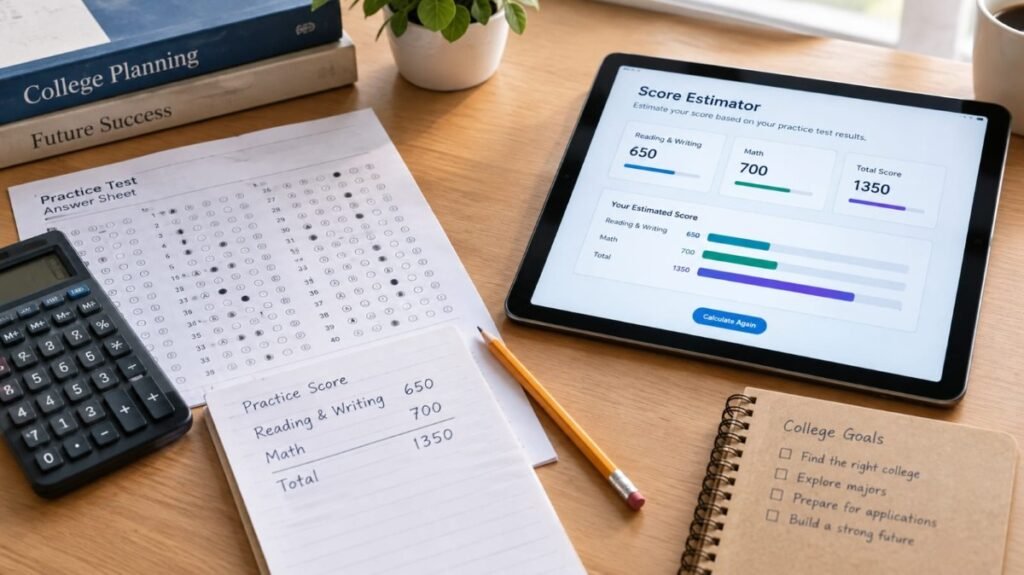
If you have taken an SAT practice test and are staring at the number of questions you got right, you probably want to know one thing: What SAT score does that translate to?
That is where a SAT score calculator can be useful.
But there is an important detail about the current digital SAT: you cannot accurately calculate your final SAT score by simply taking the percentage of questions you answered correctly and converting it to a number out of 1600.

The digital SAT uses adaptive testing and a scoring method called Item Response Theory (IRT). Your score depends not only on how many questions you answer correctly, but also on the characteristics and difficulty of the questions you answered.
So, if you’re looking for an SAT score calculator, the goal should be to get a reasonable estimate from a practice test—not to expect a perfect prediction of your official SAT score.
In this guide, we’ll explain how SAT scoring works, how to estimate your score, why two students can get different scores with the same number of correct answers, and how to use your estimated score to plan your next steps.
What Is an SAT Score Calculator?
An SAT score calculator is a tool or method that helps students estimate their SAT score based on practice-test performance.
Typically, students enter information such as:
- Number of questions answered correctly
- Reading and Writing performance
- Math performance
- Practice-test results
- Sometimes module-level performance
The calculator then provides an estimated SAT score or score range.
For older versions of the SAT, simple raw-score conversion tables were more straightforward. With today’s digital SAT, however, the calculation is more complicated because the test is multistage adaptive.
That means an online SAT score calculator should be treated as an estimate, especially when you are calculating a score from a practice test.
For the most reliable practice-score estimate, use the scoring information provided with the specific official practice test you’re taking.
How Is the SAT Scored?
The current SAT has two main sections:
- Reading and Writing
- Math
Each section is scored from 200 to 800 points.
Your total SAT score is the combination of those two section scores, giving you a total score between 400 and 1600.
| SAT Section | Score Range |
|---|---|
| Reading and Writing | 200–800 |
| Math | 200–800 |
| Total SAT Score | 400–1600 |
For example, imagine a student receives:
- Reading and Writing: 650
- Math: 720
The total score would be:
650 + 720 = 1370
So the student’s estimated SAT score would be 1370.
This part is simple.
The more complicated part is figuring out what section score you should receive based on the number of questions you answered correctly.
Can You Calculate Your SAT Score From the Number of Correct Answers?
Not exactly.
This is one of the biggest misunderstandings students have about the SAT.
You might think:
“If I got 80% of the questions right, I should get about 80% of 1600.”
That’s not how the current SAT works.
The digital SAT uses a multistage adaptive design. Each section has two modules. The questions in the second module are selected based partly on how you performed in the first module.
The scoring process also considers characteristics of the questions you answered.
Because of this, the same number of correct answers does not always produce the same reported score.
College Board gives an example showing that a student can answer fewer Math questions correctly on one practice test and still receive a higher score than on another test. Differences in question difficulty and the scoring model can affect the result.
That’s why a basic “number correct → percentage → SAT score” formula isn’t reliable for the digital SAT.
How to Estimate Your SAT Score
If you’ve completed an official SAT practice test, the best approach is to use the scoring information provided for that specific test.
For example, an official College Board practice-test scoring guide converts raw performance into a Reading and Writing score range and a Math score range, which can then be combined into a total SAT score range.
A simplified example might look like this:
| Section | Estimated Score |
|---|---|
| Reading and Writing | 620 |
| Math | 690 |
| Estimated Total | 1310 |
The calculation is:
620 + 690 = 1310
This gives you a useful estimate of where you currently stand.
If you’re using a third-party SAT score calculator, make sure you understand whether it is designed for the current digital SAT. A calculator based on an older SAT scoring system may give you misleading results.
SAT Score Calculator Formula
There is a simple formula for calculating the total score once you know your two section scores:
SAT Total Score = Reading and Writing Score + Math Score
For example:
700 Reading and Writing + 680 Math = 1380 SAT
Another example:
580 Reading and Writing + 620 Math = 1200 SAT
And:
760 Reading and Writing + 740 Math = 1500 SAT
The addition itself is easy.
The difficult part is estimating the 200–800 section scores from the number of correct answers.
That’s why a reliable SAT score calculator needs to account for the scoring method rather than simply calculating a percentage.
SAT Score Calculator for Practice Tests
If you’re taking SAT practice tests regularly, a score calculator can still be very useful.
The goal isn’t to predict your exact official score months before test day.
Instead, use your practice score to answer questions like:
- Am I improving?
- Which section is holding me back?
- Am I close to my target score?
- Should I take another practice test?
- Which skills should I study next?
- Is my current score competitive for the colleges I’m considering?
For example, suppose your practice results look like this:
| Practice Test | Reading & Writing | Math | Total |
|---|---|---|---|
| Test 1 | 560 | 590 | 1150 |
| Test 2 | 590 | 610 | 1200 |
| Test 3 | 620 | 630 | 1250 |
| Test 4 | 640 | 660 | 1300 |
The important thing isn’t just that your latest score is 1300.
You can see a consistent upward trend.
That’s much more useful for planning your preparation than worrying about whether a calculator predicts 1290, 1300, or 1310.
Why Two Students Can Get Different SAT Scores
Two students can answer the same number of questions correctly and still receive different scores.
That may sound strange at first, but it makes more sense once you understand adaptive testing.
The digital SAT uses two modules in each section.
The first module includes a broad mix of question difficulties. Based on performance in that first module, a student receives a second module with a targeted mix of questions.
The scoring model then considers the student’s responses and the characteristics of the questions.
So imagine two students both answer 35 Math questions correctly.
It does not necessarily mean both students will receive the exact same Math score.
That’s why you should be careful with calculators that claim something like:
35 correct = exactly 650
There isn’t a universal conversion like that for every digital SAT administration.
Does Getting More Questions Right Always Mean a Higher SAT Score?
Generally, strong performance is obviously important, but the relationship between the number of correct answers and the final scaled score isn’t as simple as a straight line.
The digital SAT is designed to measure student ability using an adaptive scoring system.
College Board explains that the scoring model considers the pattern of answers as well as characteristics of the questions.
This is also why students shouldn’t panic if a practice score doesn’t match what they expected from their raw number of correct answers.
Instead of asking:
“How many did I get right?”
also ask:
“What skills did I miss, and why?”
That question will help you improve.
What Is a Good SAT Score?
There isn’t one SAT score that is automatically “good” for every student.
A score that works well for one student’s college list may be different for another student’s goals.
Your target score should depend on:
- The colleges you’re considering
- Your intended major
- Your academic record
- Whether a school is test-optional or requires scores
- The typical scores of admitted students
- Your own preparation timeline
If you’re trying to understand how your score compares with other students, you can also look at SAT score percentiles.
For a broader explanation of score ranges and how to think about your target, see What Is a Good SAT Score?.
The important thing is not to chase a particular number just because someone online calls it a “good score.”
SAT Score Calculator vs. SAT Score Percentile
These two things answer different questions.
An SAT score calculator estimates your SAT score based on your practice performance.
An SAT percentile tells you how your score compares with other test takers.
For example, a calculator might help you estimate that your practice performance corresponds to a 1320.
A percentile can then help you understand how that 1320 compares with other students.
Your college list is another part of the picture.
A score that is strong for one school may be below the typical range for another.
That’s why students should avoid treating a single SAT score as an absolute measure of college readiness.
How to Use Your SAT Score Estimate
Once you have an estimated score, don’t stop there.
Use it to make a study plan.
Step 1: Look at Your Total Score
Start with your estimated total.
If you’re currently around 1150 and your goal is 1300, you know you have a 150-point gap to work on.
Step 2: Compare Your Sections
Next, look at Reading and Writing and Math separately.
Suppose you have:
- Reading and Writing: 540
- Math: 650
Your Math performance is already stronger.
In this situation, spending every study session on Math may not be the best use of your time.
You may get a better return by focusing on Reading and Writing skills.
Step 3: Review Your Mistakes
Don’t simply take another practice test immediately.
Go through the questions you missed.
Ask:
- Did I misunderstand the question?
- Did I make a careless mistake?
- Did I run out of time?
- Did I not know the concept?
- Did I change a correct answer?
- Did I guess?
The answer tells you what kind of problem you’re dealing with.
Step 4: Practice Again
After reviewing your mistakes, spend some time working on those specific skills.
You can also use your site’s SAT practice test resources to continue tracking your progress.
How Accurate Are SAT Score Calculators?
It depends on the calculator.
A calculator based on an official practice-test scoring guide can give you a useful estimate for that particular practice test.
A generic online calculator may be less reliable if it assumes that the SAT works like a traditional fixed-form test.
Your official SAT score comes from College Board’s scoring system, not from an online calculator.
So think of an SAT score calculator as a planning tool, not an official score generator.
For the most authoritative explanation of how SAT scores are calculated, check College Board’s official SAT scoring information.
Can an SAT Score Calculator Predict Your Official Score?
It can provide an estimate, but it cannot guarantee your official score.
Your actual SAT performance can be affected by things that don’t show up perfectly in a practice calculator, including:
- Test-day conditions
- Timing
- Stress
- Question difficulty
- Adaptive module performance
- The particular SAT administration
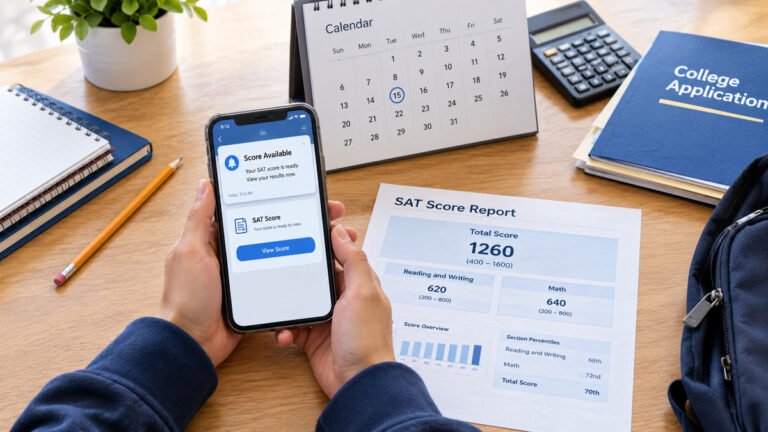
Your official score report will show your total score and the two section scores. College Board also reports a score range showing how much your score might vary if you took another administration under similar conditions.
That range is a useful reminder that one SAT score shouldn’t be viewed as an exact measurement of everything a student knows.
What SAT Score Should You Aim For?
Start with your college goals rather than choosing an arbitrary number.
If you’re just beginning SAT preparation, take a realistic practice test and establish a baseline.
Then ask:
Where am I now?
Where do I want to be?
How much time do I have?
For example, a student scoring 1050 with six months available for preparation may have a very different strategy from a student scoring 1350 with only a few weeks before the test.
Your goal should be challenging but realistic.
It’s also worth remembering that College Board’s current college and career readiness benchmarks are 480 for Reading and Writing and 530 for Math. Meeting a benchmark is useful information, but it does not mean that every college will consider that score competitive.
Don’t Confuse a Practice Estimate With Your Official Score
One of the easiest mistakes is becoming too attached to a practice-test number.
If a calculator estimates a 1280, don’t assume your official SAT will definitely be 1280.
And if it estimates 1180, don’t assume you can’t reach 1300.
Practice tests are most valuable when you use them to understand your current performance and improve.
If you’re preparing for an upcoming test, you may also want to review the SAT test dates for 2026 so you can work backward from your test date and build a realistic study schedule.
Frequently Asked Questions About SAT Score Calculators
1. Is there an official SAT score calculator?
College Board provides official scoring information and practice-test scoring guides, but students should not assume that a simple calculator can convert every number of correct answers into one exact official SAT score. The digital SAT uses adaptive scoring.
2. How do I calculate my SAT score?
Your total SAT score is the sum of your Reading and Writing score and Math score. Each section ranges from 200 to 800, producing a total range of 400 to 1600.
3. Can I calculate my SAT score from the number of correct answers?
Not reliably for the current digital SAT. Because the test is adaptive and uses an IRT-based scoring model, the same number of correct answers does not necessarily produce the same scaled score.
4. What is the highest SAT score?
The highest possible total SAT score is 1600, made up of 800 in Reading and Writing and 800 in Math.
5. What is the lowest SAT score?
The SAT total score range begins at 400. Each section has a minimum score of 200.
6. Why did I get a different score than expected from my practice test?
The digital SAT’s adaptive design and scoring methodology mean that raw correct-answer counts don’t translate into a fixed score in the way many students expect.
7. Is a 1200 a good SAT score?
A 1200 can be a solid score, but whether it is a good target depends on your college list and individual goals. Compare your score with the schools you’re considering rather than relying on one universal definition of “good.”
8. Should I use an SAT score calculator after every practice test?
You can, but the more important step is reviewing your mistakes. Track your score over several practice tests and look for patterns in your Reading and Writing and Math performance.
9. Can an SAT calculator predict my college chances?
No. An SAT score calculator estimates your test score. It cannot accurately predict admission because colleges consider many factors beyond SAT performance.
10. Where can I find official information about SAT scoring?
The best source is College Board’s official SAT scoring information. Always use official College Board resources when you need current details about scoring, testing, or score reports.
Final Thoughts
A SAT Score Calculator can be a useful part of your SAT preparation, but it shouldn’t be treated as an official score predictor.
The biggest thing to remember is that today’s digital SAT is adaptive. Your final score isn’t simply a percentage of questions answered correctly. College Board uses an adaptive scoring system that takes the characteristics of the questions and your response pattern into account.
So use calculators for what they’re good at: estimating your practice performance and tracking progress.
Then go one step further.
Look at your Reading and Writing score. Look at your Math score. Review the questions you missed. Find the skills that need work. Take another practice test after you’ve had time to improve.
Over time, that process will tell you much more than a single calculator result.
And when you eventually receive your official SAT score, you can use that number—along with your score report and college goals—to make a smarter decision about your next step.


No Comments